
La Galleria delle Applicazioni raccoglie un'ampia varietà di tutorial e di app dimostrative realizzati con COMSOL Multiphysics in diversi ambiti applicativi, inclusi quelli elettrico, meccanico, fluidico e chimico. E' possibile scaricare i file dei modelli e delle app demo pronti all'uso e le istruzioni step-by-step per costruirli, e utilizzarli come punto di partenza per le proprie simulazioni.
Lo strumento di Ricerca Rapida permette di trovare i modelli che si riferiscono alla propria area di interesse.
Si noti che molti degli esempi qui presentati sono accessibili anche tramite le Librerie delle Applicazioni incorporate nel software COMSOL Multiphysics® e disponibili dal menu File.
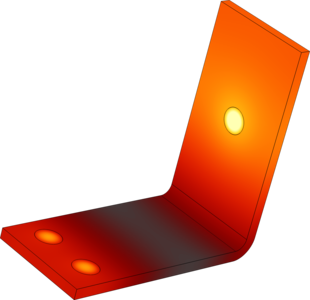
This example demonstrates the usage of current terminal to compute the resistive heating of a busbar. Per saperne di più
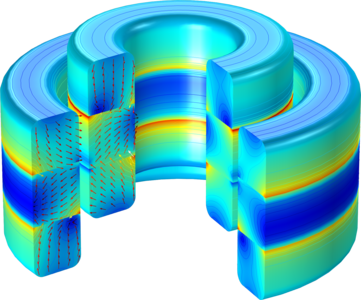
Permanent magnet bearings are used in turbomachinery, pumps, motors, generators, and flywheel energy storage systems, to mention a few application areas; contactless operation, low maintenance, and the ability to operate without lubrication are some key benefits compared to conventional ... Per saperne di più
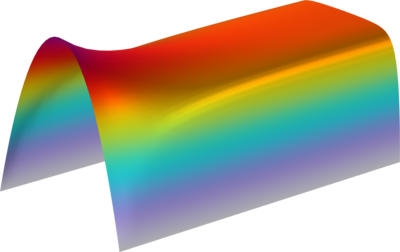
Classical MHD benchmark problem was solved analytically by J. Hartmann. He considered laminar incompressible flow between two planes (in planar duct) in transversal imposed magnetic field under next assumptions: * fully developed flow (far from inlet) * fluid properties are constant * ... Per saperne di più

The dielectric shielding boundary condition is meant to approximate a thin layer of material with high relative permittivity compared to its surroundings. This boundary condition is available for electrostatic field modeling. This example compares the dielectric shielding boundary ... Per saperne di più

This example demonstrates a benchmark test showing that Electric Currents in Layered Shells physics interface can be used to obtain the same results as when the model is solved with the Electric Currents interface based on a solid 3D structure. Per saperne di più

Every electrical device has some resistance. That is, when a voltage difference is applied across any two terminals of the device, there will be a directly proportional current flow. This model demonstrates how to compute the resistance of a short section of copper wire. The convergence ... Per saperne di più
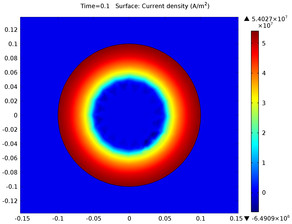
Superconducting materials have zero resistivity up to a certain critical current density, above which the resistivity increases rapidly. To model such a material, this example uses the Magnetic Field Formulation physics interface. The model was based on a suggestion by Dr. Roberto ... Per saperne di più

The electrostatically tunable parallel plate capacitor in this example is a typical component in various MEMS devices for radio frequencies that range between 300 MHz and 300 GHz. You can modify the distance between the two plates, as the applied voltage changes, through a spring ... Per saperne di più


