
In conformità con la nostra Quality Policy, COMSOL ha pubblicato una libreria con centinaia di esempi di modelli documentati che vengono regolarmente testati rispetto all'ultima versione del software COMSOL Multiphysics®, compresi i problemi di benchmark di ASME e NAFEMS, così come TEAM problems.
I nostri test di verifica e validazione (V&V) forniscono soluzioni sempre accurate che vengono confrontate con i risultati analitici e i dati di riferimento stabiliti. I modelli documentati qui sotto fanno parte delle Application Library integrate nel software COMSOL Multiphysics®. Includono inoltre valori di riferimento e fonti per un'ampia gamma di benchmark, così come istruzioni passo-passo per riprodurre i risultati sul proprio computer. Questi modelli possono essere usati non solo per documentare l'impegno nella garanzia di qualità del software (SQA) e nella verifica del codice numerico (NCV), ma anche come parte di un programma di formazione interno.
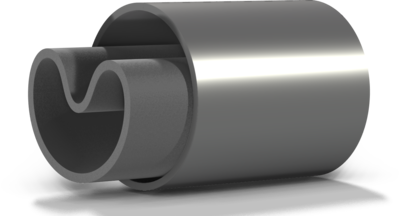
In this example, the Bergstrom–Bischoff material model is used to model the temperature and strain dependent behavior of High Density Polyethylene (HDPE) used, for example, to make liners for damaged pipes in oil and gas applications, or to make type IV hydrogen storage vessels for fuel ... Per saperne di più
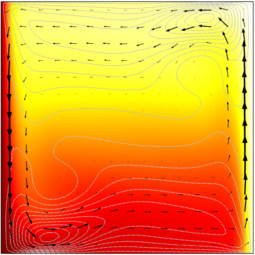
This model couples the Navier Stokes equations and the heat transfer equations to examine density driven flow of free fluids. Here the fluid is in a square cavity with a heated wall. The buoyancy force is a Boussinesq term added to the Navier-Stokes equations. The equation is ... Per saperne di più
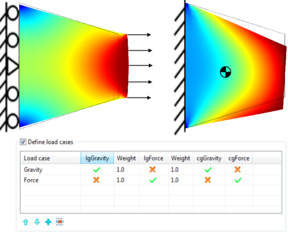
This example shows a 2D plane stress model of a thin tapered cantilever. Different boundary and load scenarios are examined. It is demonstrated how to apply and how to evaluate different load and constraint groups. Resulting stresses are compared to NAFEMS benchmark values and they are ... Per saperne di più
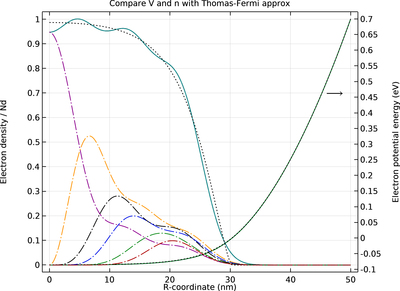
This benchmark model simulates a GaAs nanowire using the self-consistent Schrödinger-Poisson theory to compute the electron density and the confining potential profiles. The predefined Schrödinger-Poisson multiphysics coupling feature is combined with the dedicated Schrödinger-Poisson ... Per saperne di più
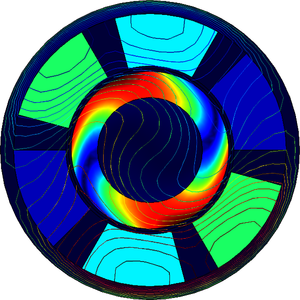
This three-phase induction motor model is used to compare with Testing Electromagnetic Analysis Method (TEAM) workshop problem 30. The Magnetic Fields physics interface is used to model the motor in the frequency domain at 60 Hz. The Velocity (Lorentz Term) feature is used to model the ... Per saperne di più

The vibration modes of a thin or thick circular disc are well known, and it is possible to compute the corresponding eigenfrequencies to arbitrary precision from a series solution. The same is true for the acoustic modes of an air-filled cylinder with perfectly rigid walls. A more ... Per saperne di più
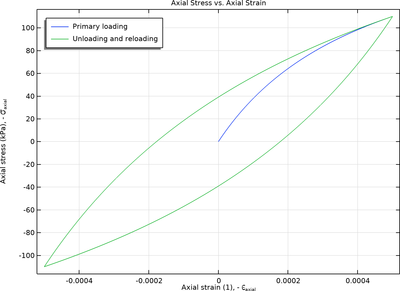
The small strain overlay material model captures the effect of high stiffness at low strain as well as the hysteresis under cyclic loading, which is a common effect for most soils. The formulation allows stiffness degradation with an increase in shear strain, and the full recovery of ... Per saperne di più
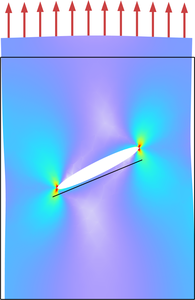
This example reproduces a NAFEMS benchmark in which a plate with an angle crack is subjected to tensile loading. The J-integral is calculated and the stress intensity factors for Mode I and Mode II are compared to the benchmark results for several crack angles. Per saperne di più

In this example, a settlement and heave analysis of a shallow foundation resting on an unsaturated soil stratum is conducted with the Modified Cam-Clay and Extended Barcelona Basic soil models. The effect of pore suction due to movements in the phreatic line and the resulting settlement ... Per saperne di più
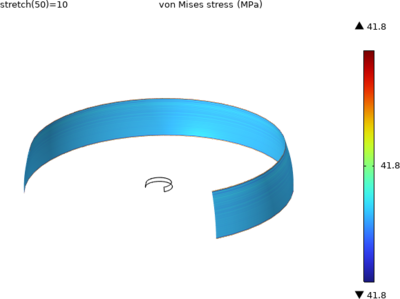
This version of the balloon inflation example demonstrates how the Shell and Membrane interfaces can be used to model thin structures made of hyperelastic materials. The example is identical to the Model Library model 'Inflation of a spherical rubber balloon', except that the Membrane ... Per saperne di più


