
Francesca Magionesi
INSEAN
Italy
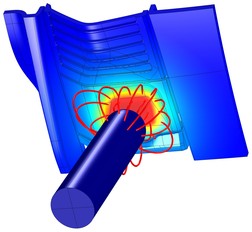
There has been a recent move towards utilizing bulbous bows on ships to house different types of sonar systems, but it is not definite how much structural vibration might interfere with the functioning of a transducer array inside the sonar dome. INSEAN, the National Institute for Studies and Experiments of Naval Architecture in Italy, needed a way to simulate what is happening when the turbulent boundary layer interacts with the bulbous bow in order to determine how much self-noise this creates.
They first created a small-scale model to capture the turbulent boundary layer excitation and that gave them a full-scale fluid load expression. They then created a full-scale model within COMSOL Multiphysics, taking the complexity of the composite material used for the bulbous bow and the turbulent boundary layer load into account. LiveLink™ for Pro/ENGINEER® enabled the team to bring CAD data for the different parts of the bulbous bow into COMSOL Multiphysics.
Suggested Stories
Optimizing Passenger Vehicle Design with Simulation Apps
The fast-paced passenger vehicle design process at Mahindra, a multinational automotive manufacturer, demands ...
Switching Made Easy
Modern cars offer a wide range of complex functionality that comes with several design challenges. This story ...
Prototyping Antennas for Mobile Recording of TV Sports Events with Simulation
Researchers at Radiotelevisione Italiana (RAI) are optimizing circularly polarized antenna designs for recording live ...
Designing an Eco-Friendly Anode Baking Process with Numerical Modeling
Aluminum is extracted through the Hall–Héroult process, during which it is removed from bauxite using green anodes. A ...


