
Oliver Nemitz Simulates a Magnetic Flux Leakage Inspection System
Oliver Nemitz
Salzgitter Mannesmann Forschung, Duisburg, Germany
Salzgitter Mannesmann Forschung (SZMF) advances testing methods for the Salzgitter Group, a leading company that works with the manufacture of, among other things, pipes. In the manufacturing of heavy steel tubing, it is important maintain quality, which is done through conduct non-destructive testing (NDT) using large magnets to identify flaws (magnetic flux leakage inspection).
Oliver Nemitz now wants to leverage this technology to provide precise data about the extent, size or relevance of the flaws they detect; a process they have previously not done. Using the AC/DC Module, he was able to analyze signals from the inspection system on some standard samples with pre-defined flaws. With this information, he was able to provide qualitative information and a reference framework for the signals received on the factory floor.
The difference in scale between the size of the flaws and that of the test samples is very large, and would require very large meshes to provide adequate resolution for 3D modeling. Modeling the samples in 2D or using symmetries would restrict their investigations to symmetric flaws, which is of course not representative of reality. Yet, Nemitz was able to use impedance boundary conditions to take into account the skin effect, and only mesh this area and not the rest of the conductor.
Suggested Stories

Understanding the Origin of Uncertainty in Thermometer Calibration
Thermometers have widespread application and like any measurement device, they must be calibrated. Many do this with ...
Get an Inside Look at an Innovative Rainwater Drainage System
Step into a busy neighborhood in Copenhagen, Denmark, to see how a multidisciplinary urban planning team used ...
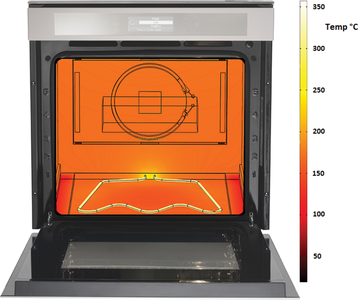
Simulation Turns Up the Heat and Energy Efficiency at Whirlpool Corporation
Engineers working on a joint research project between Whirlpool Corporation and the European initiative GREENKITCHEN ...
Simulation-Based Design of New Implantable Hearing Device
Cochlear Technology Centre Europe (CTCE) develops new technology for hearing implants. Their current work is with a ...


