
Clemson Simulates Electrode Setup for Dielectrophoresis
G. Zhang
Clemson U, SC, USA
J. Brcka, J. Faguet, E. Lee
Tokyo Electron, TX, USA
Dielectrophoresis (DEP) is a method of patterning cells and particles used in medical, electronics, and energy applications. When an electric field is applied to an array of cells or dielectric particles suspended in a medium, they become polarized, causing movement that reorganizes the particles. This is an efficient way to assemble materials layer by layer at the nanoscale, and is sometimes used in mass production of materials. Through a partnership between Clemson University and Tokyo Electron U.S. Holdings, Inc., researchers are analyzing unexpected particle rotation and alignments they have observed during cell patterning. They have used COMSOL Multiphysics models to understand cell patterns and material assembly; their simulations account for nonhomogeneous cell properties and electric field distortions, which they are analyzing to predict the influence of DEP force on this behavior.
Suggested Stories
Upgrading the Nuts and Bolts of the Electrical Grid for a New Generation
Migrating the electrical grid to a “smart grid” is usually discussed in terms of IT issues or embedded systems. Yet, ...
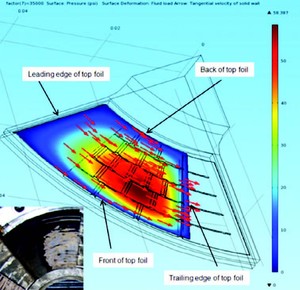
Multiphysics Analysis of CO2 Foil Thrust Bearing Characteristics
Knolls Atomic Power Laboratory (KAPL) is a research and development facility supporting the United States Naval ...
National Grid Models Underground Cable Routes
U.K. National Grid bears responsibility for maintaining the high-voltage transmission network in the U.K. Determining ...
Powering Offshore Wind Farms with Numerical Modeling of Subsea Cables
Hellenic Cables uses finite element modeling to analyze and validate underground and subsea cable designs for use in ...


