
Toyota Improves Electronic Component Cooling with Simulation
Toyota Research Institute of North America, MI, USA
The Toyota Research Institute in Ann Arbor drives cutting-edge research in energy efficiency, mobility infrastructure, and safety. Here, Ercan Dede and his team are designing heat sinks (or cold plates), which are affixed to fragile electrical systems and other applications in Toyota’s hybrid vehicles.
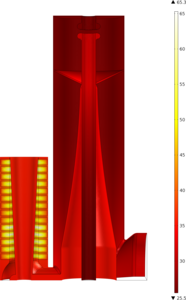
Their simulations simulate the cold plate’s topology for improved cooling efficiency while minimizing pressure drop. Previous designs provided good heat transfer, but at the cost of significant pressure drops across the plate. Making use of branching channels, the heat sinks provide the same heat transfer but with an optimized flow path. Using LiveLinkTM for SolidWorks®, they were able to create fast and accurate design iterations, leading to an optimal cold plate topology.
SolidWorks is a registered trademark of Dassault Systèmes SolidWorks Corp.
Suggested Stories
Simulation Summit Panel: The Multiphysics Roadmap
Speakers from NVIDIA, Stanford University, and MathWorks, as well as COMSOL and moderator DE 24/7, discuss the future ...
Optimizing Wireless Test Systems and Antennas for High-Speed Communication
To design reverberation systems for measuring the performance of wireless devices and wideband antennas, engineers at ...
Addressing Oil Spill Cleanup Using Hydrophobic Meshes
Engineers at Amphos 21 tested a new solution for different oil spill scenarios, hydrophobic meshes, with numerical ...
Doubling Beam Intensity Unlocks Rare Opportunities for Discovery at Fermi National Accelerator Laboratory
Behind the discovery of the most fundamental and rare physical processes within our universe is powerful technology, ...


