
Using Simulation to Rapidly and Precisely Model Nanoresonators
J. Yang, M. Perrin, P. Lalanne
CNRS, France
Nanoresonators, or optical nanoantennas, manage the concentration, radiation, and absorption of light at the nanometer scale and show stunning promise for future improvements to technology, such as sensors, computers, and other electronics. However, the ways that these devices scatter light and interact with their surrounding environment are not well understood, nor are the electromagnetic properties of the complex metal shapes that comprise them. Numerical approaches to calculating the resonance modes and excitations in nanoresonators have historically been cumbersome and error-prone.
Now, researchers and engineers at Institut d’Optique d’Aquitaine (Paris, France) are using COMSOL Multiphysics simulations to rapidly and precisely determine physical properties, calculate the resonance modes, and analyze the electromagnetic fields and scattering that occur due to excitation. They expect that their new approach to modeling these nanoresonators will lead to advancements in the development and use of nanoelectromechanical devices (NEMS) for a wide range of applications such as photovoltaics, spectroscopy, and improved electronic systems.
Suggested Stories
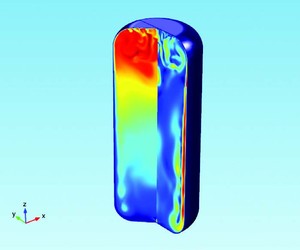
Modeling Helps Improve Safety in the Production of Teflon
BAM German Federal Institute for Materials Research & Testing in Berlin promotes industrial development by ...
Greening the Heart of the City: An Urban Rooftop Drainage System Inside a Garden Fence
TL-Engineering, a simulation consultant, teamed up with a professor, civil engineer, and sound barrier company to ...
Innovative Motor Designs for Electric Cars Come to Life
If electric vehicles are to ultimately transcend from niche to mainstream, their motor designs must continually ...
Keynote: Multiphysics Modeling in AR & VR Innovation
Meta is working to advance the optical and display technologies for its augmented reality (AR) and virtual reality ...


