
SRON Develops Thermal Calibration System for Deep-Space Telescope
C. de Jonge
SRON, Netherlands
Deep-space telescopes require ultrasensitive detectors and calibration to pick up weak far-infrared signals. The SpicA Far-InfraRed Instrument (SAFARI), an infrared camera that will fly aboard the Space Infrared Telescope for Cosmology and Astrophysics (SPICA), has sensors that measure the far-infrared spectrum. The SAFARI system includes a radiation source, needed for calibration, that is so powerful it can throw off the readings. Thus, heat management becomes a vital consideration, as the sensors must be kept at cryogenic temperatures. Stainless steel suspension strings hold the radiation source to a frame, preventing it from contacting other equipment and minimizing heat transfer and vibrations. Chris de Jonge, design engineer at the SRON Netherlands Institute for Space Research, has used COMSOL Multiphysics to aid in the design of this thermally insulating suspension system. He also used his COMSOL simulation results to optimize the geometry of an iris and shutter mechanism inside the calibration system, developing an optimal coil design and minimizing current and heat dissipation.
Suggested Stories
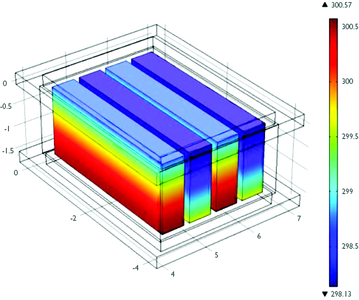
Simulation Helps Improve Atmosphere Revitalization Systems for Manned Spacecraft
To ensure astronaut safety on space missions, it is necessary to routinely revitalize the atmosphere in manned ...
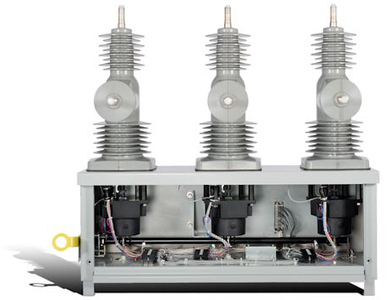
How Reclosers Ensure a Steady Supply of Power: It’s All in the Magnet
When a tree branch touches overhead cables and causes a momentary short circuit, your lights may flicker. A device ...
Meeting High-Speed Communications Energy Demands Through Simulation
The information and communication technology industry needs new energy-efficient devices that can keep up with the ...
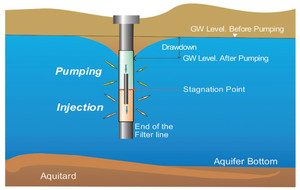
Pumping and Injecting from a Single Borehole
Professor Dr. Martin Sauter leads a group at the University of Göttingen in research on hydrogeology. Cooperating with ...


