
NEXT ENERGY Analyzes Heat Transfer in Lithium-Ion Batteries
Gerd Liebig, Pamina Bohn, NEXT ENERGY EWE Research Centre for Energy Technology, Germany
Lithium-ion batteries, which have a tendency to degrade at high temperatures, must adhere to stringent regulations guaranteeing their ability to withstand operating temperature fluctuations. Researchers at NEXT ENERGY used heat transfer modeling to study whether high welding temperatures can create enough temperature propagation within cells to cause irreversible damage, such as electrolyte decomposition and capacity loss. They discovered that tab welding can, in fact, induce irreversible damage, but laser welding is significantly less detrimental.
Suggested Stories
Invisible Connections Will Unveil our 5G Future
The impending evolution of ultrafast 5G networks from concept to reality will entail significant effort into the ...
Designing Smart Solutions for Gas Flow Devices with Multiphysics Simulation
As India moves toward a reduced dependence on fossil fuels, researchers at Raychem RPG used multiphysics simulation to ...
Elevating the Performance of Ionization Gauges with Simulation
Semiconductor manufacturing and particle physics research depend on high-vacuum or ultra-high-vacuum (HV/UHV) ...
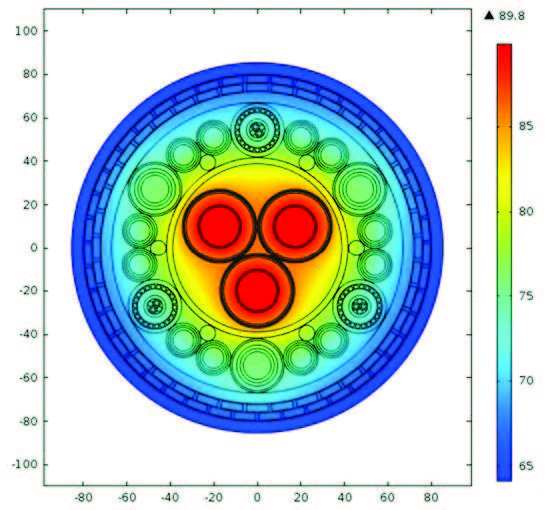
Simulation Software Brings Big Changes to Cable Industry
The design and testing of high-voltage cables for terrestrial and submarine applications is paramount to Prysmian's ...


