
Jean-Louis Gelet and Antoine Gerlaud
Mersen, France
Large electrical systems carrying high currents could pose a danger if any of their components, such as fuses and bus bars, fail. In order to increase safety and improve manufacturing, it is necessary to understand the failure mechanisms of those components. One of those components, a bus bar, is made up of a single piece of conducting metal that replaces individual, thick cables when conducting a large current across a short distance and to many loads.
Mersen, an international company with expertise in surge protection, manufactures bus bars that are laminates with a film of insulating material glued between conducting plates at different potentials. If the temperature in a bus bar gets too high, however, the glue or insulation can be destroyed.
A group at Mersen, focusing on electric protection, used COMSOL simulations to determine the temperature field generated by the Joule effect, and eliminate any identified hot spots.
Suggested Stories
From Nanoantennas to Deep Space Satellites, Electron Emission Enables Efficient Power Generation
Researchers from the Italian Institute of Technology (IIT) and the European Space Agency (ESA) are developing power ...
On the Cutting Edge of Hearing Aid Research
Nearly 20% of the United States population has some degree of hearing impairment. Despite the relative ...
Current Transformer Design That Combines Finite Element Analysis and Electric Circuit Simulation
Transformers have been around for quite a while but their fundamentals are still being investigated by ABB in ...
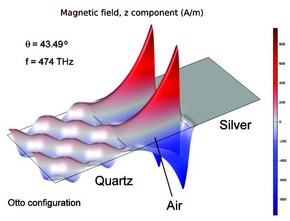
Surface Plasmon Resonance
Surface Plasmon Resonance (SPR) is created by surface plasmons, coherent electron oscillations existing between any ...


