
Sunwell and UMass Dartmouth Research Teams Optimize Refrigeration Systems for Food Transportation
Stephen Codyer & Mehdi Raessi
Department of Mechanical Engineering
UMass Dartmouth
Dartmouth, MA
Jessica Currie & Vladimir GoldsteinSunwell Technologies, Inc., Woodbridge
ON, Canada
Sunwell Technologies Inc. produces and distributes the slurry ice (Deepchill™) that is an environmentally-friendly way to refrigerate foods and other items in trucks and the like. They commissioned the Computational Multiphase Flows group at the University of Massachusetts, Dartmouth (UMass Dartmouth) to provide simulation support to the experimental investigations performed by Sunwell.
Known as a thermo battery, Deepchill uses a flowing ice slurry to keep produce chilled while in a truck. Optimizing the flow and positioning of the slurry is important for keeping the produce chilled in a uniform manner. As these refrigerated systems can be quite large, it would be quite difficult, expensive and time consuming to perform encompassing experimental investigations on real-life systems.
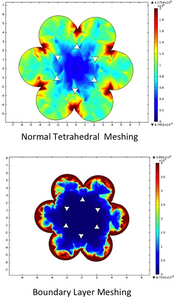
Modeling the non-isothermal flow of the ice slurry allowed Sunwell and the university team to investigate specific design criteria, including average and maximum temperatures of specific domains. The simulations were performed on UMass Dartmouth’s Scientific Computing Group HPC cluster that contrains72 nodes, each with two Intel Xeon (quad-core) processors.
Suggested Stories
Keynote: Democratizing In Silico Ablation R&D via Simulation Apps
In this keynote talk from COMSOL Day: MedTech, Marcela Mercado Montoya of IN SILICO STEM introduces the capabilities ...
Optimized Induction Heating Techniques Improve Manufacturing Processes
Induction heating has become a valuable tool used by the steel industry for manufacturing various metal products. The ...
Bringing Lab Courses to Remote Learning Students with Simulation Applications
A professor at the New Jersey Institute of Technology built 15 simulation applications for use in chemical engineering ...
Manipulate and Control Sound: How Mathematical Modeling Supports Cutting-Edge Acoustic Metamaterials Research
Researchers at Duke University are using numerical modeling to develop metamaterial structures for acoustic cloaking. ...


