
Lorenzo Bortot, CERN, Switzerland
Engineers and physicists at CERN go to great lengths to ensure that the high-power superconducting magnets that maintain the circular trajectory of particles inside the Large Hadron Collider (LHC) do not revert to a resistive state, an event known as a quench. To understand and prevent quench events, Lorenzo Bortot, an electrical engineer and research fellow at CERN, used numerical simulation to develop a multiphysics, multiscale, and multirate representation of the electrodynamics and thermal evolution of a quench event.
Suggested Stories
Prototyping Antennas for Mobile Recording of TV Sports Events with Simulation
Researchers at Radiotelevisione Italiana (RAI) are optimizing circularly polarized antenna designs for recording live ...
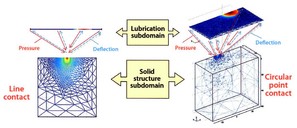
Shape Changing Lubricants
Shell Global Solutions UK is conducting research to optimize lubricants for the fuel economy. A problem exists in ...
Illuminating the Physics Behind Electromagnetics Concepts with Applications
Electrical engineering students find it hard to visualize the electromagnetics concepts they are learning. To remedy ...
Multiphase Flow Simulation Guides Wastewater Treatment Plant Design
To improve the health of the Dommel river, an aeration unit has been added to the Eindhoven wastewater treatment plant ...


