
Lorenzo Bortot, CERN, Switzerland
Engineers and physicists at CERN go to great lengths to ensure that the high-power superconducting magnets that maintain the circular trajectory of particles inside the Large Hadron Collider (LHC) do not revert to a resistive state, an event known as a quench. To understand and prevent quench events, Lorenzo Bortot, an electrical engineer and research fellow at CERN, used numerical simulation to develop a multiphysics, multiscale, and multirate representation of the electrodynamics and thermal evolution of a quench event.
Suggested Stories
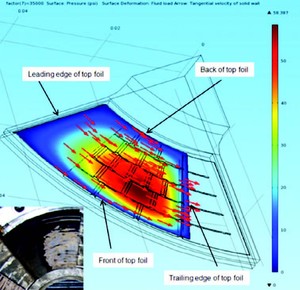
Multiphysics Analysis of CO2 Foil Thrust Bearing Characteristics
Knolls Atomic Power Laboratory (KAPL) is a research and development facility supporting the United States Naval ...
The Brains of Banknote Processing Systems
Giesecke+Devrient Currency Technology develops sensors for modular, high-performance banknote processing systems that ...
Get an Inside Look at How Samsung Uses Acoustics Simulations
Step into the state-of-the-art Samsung Audio Lab to see how they develop loudspeakers, soundbars, and other audio ...
Keeping Dendrites at Bay with Numerical Simulation
To design a lithium-ion battery that functions efficiently, engineers at Murata Manufacturing Co., Ltd. are using ...


