
A Research Team Uses Simulation to Challenge a 150-Year-Old Theory
Juan Carlos Miñano and Dejan Grabovičkić
Cedint Polytechnic University of Madrid
Spain
The idea of "perfect imaging", that is a resolution less than the wavelength of light producing the image, was first proposed in the mid-19th century by famed Scottish physicist James Clerk Maxwell. For the next 150 years, it was widely believed that such was impossible due to the fact that light diffracts around points that are the same size or smaller in wavelength. Then, in 2009, Ulf Leonhardt, of the University of St. Andrews in Scotland, theoretically analyzed the phenomenon and demonstrated its focus was not restricted by the diffraction limit.
A research team at the Cedint Polytechnic University of Madrid used simulation to demonstrate Leonhardt’s proposal and prove that diffraction limits can be surpassed. The team proposed using a device to do this, which they called a spherical geodesic waveguide (SGW).
Using COMSOL Multiphysics and the RF Module, the research team was able to demonstrate that these SGWs could be manufactured for certain applications such as microwaves. Their next goal is to design a dielectric SGW that will work in the visible spectrum.
Suggested Stories
Industrial Applications of Carbon and Graphite for Thermal Management
At GrafTech International, engineers develop carbon and graphite products for applications from consumer electronics ...
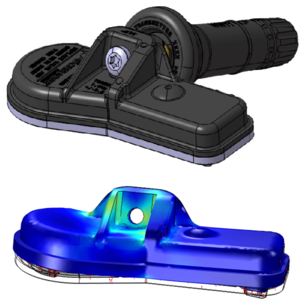
Optimizing Built-in Tire Pressure Monitoring Sensors
Built-in tire pressure sensors need to be able to withstand the wear and tear of working within a car’s tire rim. ...

Sonar Dome Vibration Analysis
There has been a recent move towards utilizing bulbous bows on ships to house different types of sonar systems, but it ...

Analysis of Subsea Umbilicals and Cables
JDR Cables designs-to-spec and manufactures subsea umbilical systems of cables and reelers for the oil and gas and ...


