
La Galleria delle Applicazioni raccoglie un'ampia varietà di tutorial e di app dimostrative realizzati con COMSOL Multiphysics in diversi ambiti applicativi, inclusi quelli elettrico, meccanico, fluidico e chimico. E' possibile scaricare i file dei modelli e delle app demo pronti all'uso e le istruzioni step-by-step per costruirli, e utilizzarli come punto di partenza per le proprie simulazioni.
Lo strumento di Ricerca Rapida permette di trovare i modelli che si riferiscono alla propria area di interesse.
Si noti che molti degli esempi qui presentati sono accessibili anche tramite le Librerie delle Applicazioni incorporate nel software COMSOL Multiphysics® e disponibili dal menu File.
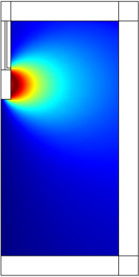
This model presents a 2D axisymmetric dipolar microwave plasma source sustained through resonant heating of the electrons. This is known as electron cyclotron resonance (ECR), which occurs when a suitable high magnetic flux density is present along with the microwaves. This is an ... Per saperne di più

This tutorial model demonstrates how to use the Combined Inductively/DC Discharge interface to simulate the plasma generated in a pulsed arc. This modeling technique is useful for a large range of industrial applications including cutting, welding, spraying, waste destruction, and ... Per saperne di più
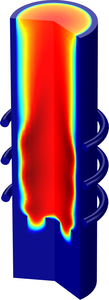
This model investigates the electrical and thermal characteristics of an inductively coupled plasma torch at atmospheric pressure. The discharge is assumed to be in local thermodynamic equilibrium. Per saperne di più
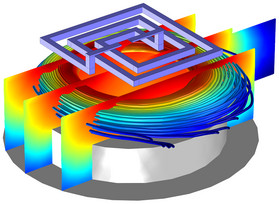
The COMSOL® software includes capabilities for 3D plasma modeling. In this example, a square coil is placed on top of a dielectric window and is electrically excited at 13.56 MHz. A plasma is formed in the chamber beneath the dielectric window, which contains argon gas at low ... Per saperne di più
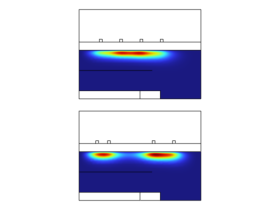
This model shows how shape optimization can be used design the coils of an ICP reactor to obtain plasma uniformity. The reactor in study is a planar ICP with the coils distributed along the radial direction. The Optimization study step is used to find the best coil placement so that the ... Per saperne di più
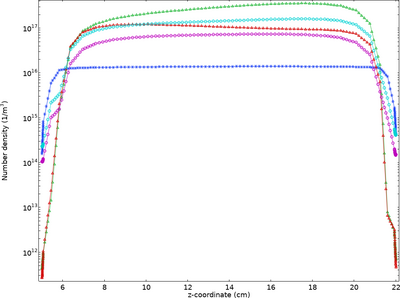
This tutorial model solves for an inductively coupled plasma reactor in a mixture of SF6/argon. The model computes the fluid flow and gas heating. Important aspects and strategies for modeling electronegative discharges are discussed. Per saperne di più

Thermoelectric coolers are widely used for electronics cooling in various application areas, ranging from consumer products to spacecraft design. The thermoelectric modules are a common application of thermoelectricity in cooling engineering. They consist of several thermoelectric legs ... Per saperne di più
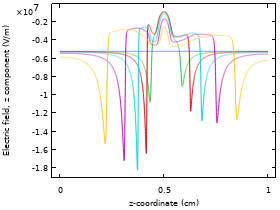
This tutorial model presents a study of a double-headed streamer in nitrogen at atmospheric pressure. An initial seed of electrons is placed between two electrodes which apply an initial electric field of 52 kV/cm to the gas. A negative and positive streamer propagate toward the ... Per saperne di più
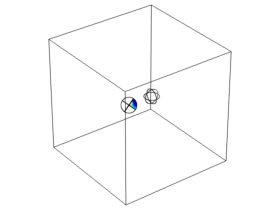
This model verifies that the onset of streamer formation between two spheres separated by atmospheric pressure dry air at a distance of 2cm occurs at 51.8kV. The electrical breakdown is detected by integrating Townsend coefficients along the electric field lines between the two spheres. ... Per saperne di più

This tutorial model solves for a hydrogen plasma created in a microwave cavity. The model computes the fluid flow and gas heating self-consistently. Per saperne di più


