
La Galleria delle Applicazioni raccoglie un'ampia varietà di tutorial e di app dimostrative realizzati con COMSOL Multiphysics in diversi ambiti applicativi, inclusi quelli elettrico, meccanico, fluidico e chimico. E' possibile scaricare i file dei modelli e delle app demo pronti all'uso e le istruzioni step-by-step per costruirli, e utilizzarli come punto di partenza per le proprie simulazioni.
Lo strumento di Ricerca Rapida permette di trovare i modelli che si riferiscono alla propria area di interesse.
Si noti che molti degli esempi qui presentati sono accessibili anche tramite le Librerie delle Applicazioni incorporate nel software COMSOL Multiphysics® e disponibili dal menu File.
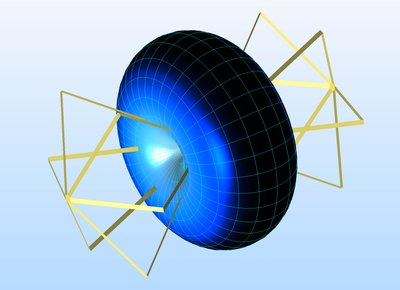
Biconical antennas are popular for very high frequency (VHF) measurement because they support a wide frequency range. They are also useful for electromagnetic compatibility (EMC) testing where the antenna can be used as an RF source in susceptibility or immunity test. This model ... Per saperne di più
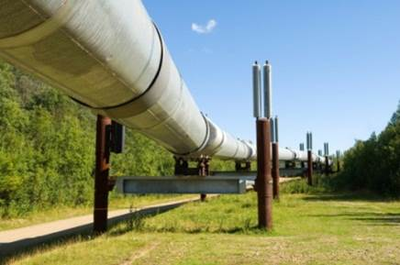
As oil flows through a pipeline section heat is released due to the work of internal friction forces in the fluid. With good insulation of the pipeline, this generated heat can be used to avoid preheating of the oil, despite the fact that it is to be transported in a cold environment ... Per saperne di più
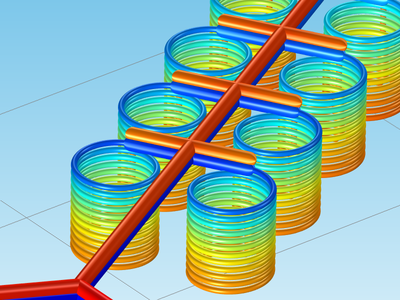
Ponds and lakes can serve as thermal reservoirs in geothermal heating applications. In this example, fluid circulates underwater through polyethylene piping in a closed system. The pipes are coiled in a slinky shape and grouped onto sleds. The Non-isothermal Pipe Flow interface sets up ... Per saperne di più
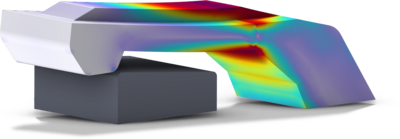
This example simulates the insertion of a snap hook in its groove. Fasteners like this are common in the automotive industry, for example, in the control panel of a car. In this case it is important to know the force that must be applied in order to place the hook in the slot and also ... Per saperne di più
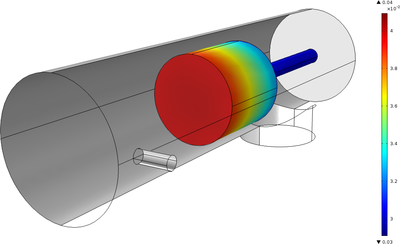
Chemical vapor deposition (CVD) is a process often used in the semiconductor industry to grow layers of high-purity solid material on top of a wafer substrate. CVD is achieved using many different techniques and across a range of pressures from atmospheric to ultrahigh vacuum (UHV/CVD). ... Per saperne di più

This model illustrates the modeling of temperature distribution in a simplified mixer. Per saperne di più
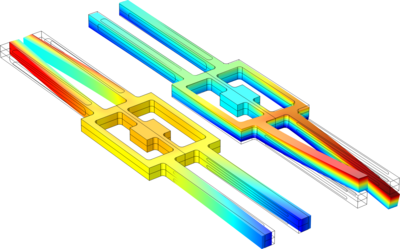
This model shows how to analyze a tuning fork based piezoelectric rate gyroscope. The reverse piezoelectric effect is used to drive an in-plane tuning fork mode. This mode is coupled to an out of plane mode by the Coriolis force and the resulting out of plane motion is sensed by the ... Per saperne di più
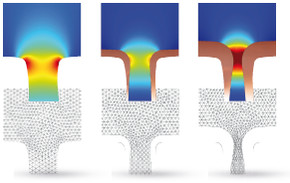
This model demonstrates the use of moving meshes in the application of copper electrodeposition on circuit boards. In these environments, the presence of cavities or 'trenches' are apparent. The model makes use of the Tertiary, Nernst-Planck interface for electrodeposition to keep track ... Per saperne di più
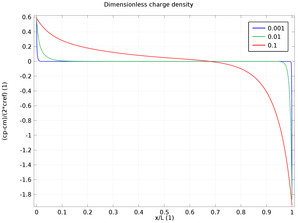
In the diffuse double layer and within the first few nanometers of an electrode surface, the assumption of electroneutrality is not valid due to charge separation. Typically, the diffuse double layer may be of interest when modeling very thin layers of electrolyte including those in ... Per saperne di più

This application demonstrates how you can access and include external thermodynamic and physical property calculations in your simulation, using the Thermodynamics feature. The example shows how you can easily modify the predefined Plug-flow reactor type in the Reaction Engineering ... Per saperne di più


