
La Galleria delle Applicazioni raccoglie un'ampia varietà di tutorial e di app dimostrative realizzati con COMSOL Multiphysics in diversi ambiti applicativi, inclusi quelli elettrico, meccanico, fluidico e chimico. E' possibile scaricare i file dei modelli e delle app demo pronti all'uso e le istruzioni step-by-step per costruirli, e utilizzarli come punto di partenza per le proprie simulazioni.
Lo strumento di Ricerca Rapida permette di trovare i modelli che si riferiscono alla propria area di interesse.
Si noti che molti degli esempi qui presentati sono accessibili anche tramite le Librerie delle Applicazioni incorporate nel software COMSOL Multiphysics® e disponibili dal menu File.
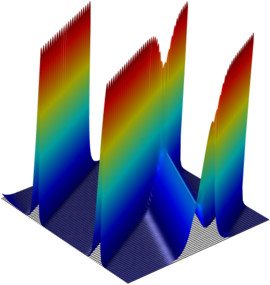
The Korteweg-de Vries (KdV) equation models water waves. It contrasts sharply to the Burgers equation, because it introduces no dissipation and the waves travel seemingly forever. Solitons have their primary practical application in optical fibers. Specifically, a fiber’s linear ... Per saperne di più
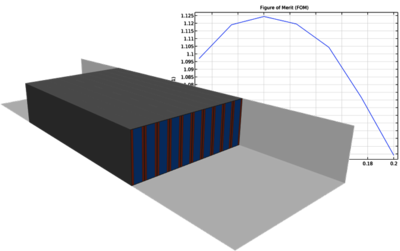
This example computes the effectiveness of a porous microchannel heat sink over a conventional microchannel heat sink. The model is fully parameterized. A parameter study on the thickness of the porous substrate is used to determine the optimal configuration. Per saperne di più

This model demonstrates how to use the Polynomial Shell feature to increase the lowest Eigenfrequency of a shell by deforming its shape. Per saperne di più
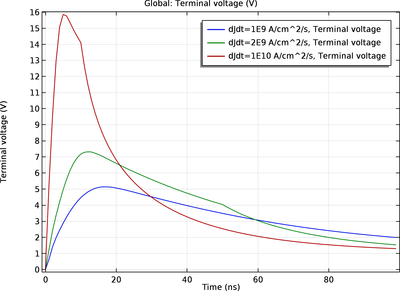
This tutorial simulates the turn-on transient (forward recovery) of a simple PIN diode, based on the book "Fundamentals of Power Semiconductor Devices" by B. J. Baliga (p. 242, 2008 edition). The diode is current driven with a constant ramp rate of 1e9, 2e9 and 1e10 A/cm^2/sec and a ... Per saperne di più
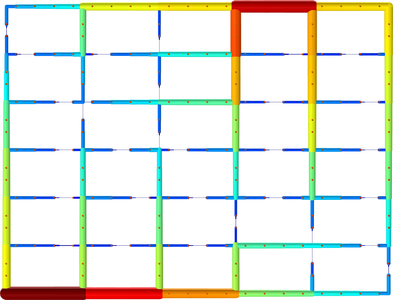
The layout of a district heating network is designed using topology optimization. Per saperne di più
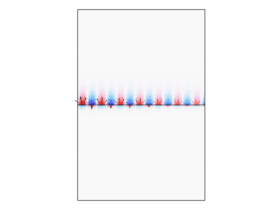
Electromagnetic waves that are confined to propagate along a surface, such as surface plasmon polaritons (SPPs), are of great research interest due to their potential applications in nanoscale manipulation of light. This model demonstrates how to set up a simulation of the propagation ... Per saperne di più
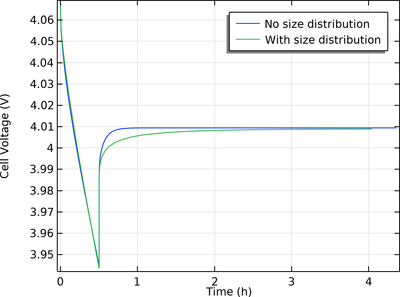
Battery electrodes featuring large heterogeneities in terms of particle sizes may sometimes not be adequately described by homogenized models using one single particle size only. As an alternative to adding multiple instances of the Additional Porous Electrode material node, this ... Per saperne di più
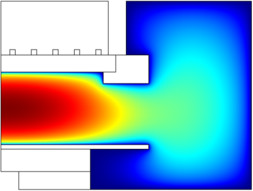
The GEC cell was introduced by NIST in order to provide a standardized platform for experimental and modeling studies of discharges in different laboratories. The plasma is sustained via inductive heating. The Reference Cell operates as an inductively-coupled plasma in this model. This ... Per saperne di più
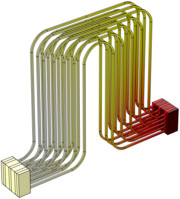
This model simulates a temperature profile in a number of cells and cooling fins in a liquid-cooled battery pack. The model solves in 3D and for an operational point during a load cycle. A full 1D electrochemical model for the lithium battery calculates the average heat source. Per saperne di più
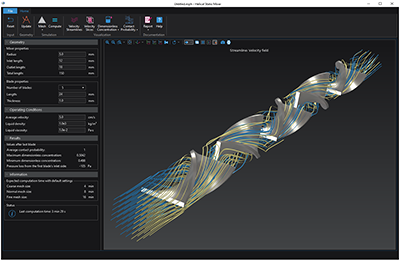
This app demonstrates the following: Geometry parts and parametric geometries Dark theme Use of subwindows Material appearance visualization with environment reflections Report generation for both Microsoft® Word and Microsoft® PowerPoint Options for setting different mesh sizes ... Per saperne di più


