
La Galleria delle Applicazioni raccoglie un'ampia varietà di tutorial e di app dimostrative realizzati con COMSOL Multiphysics in diversi ambiti applicativi, inclusi quelli elettrico, meccanico, fluidico e chimico. E' possibile scaricare i file dei modelli e delle app demo pronti all'uso e le istruzioni step-by-step per costruirli, e utilizzarli come punto di partenza per le proprie simulazioni.
Lo strumento di Ricerca Rapida permette di trovare i modelli che si riferiscono alla propria area di interesse.
Si noti che molti degli esempi qui presentati sono accessibili anche tramite le Librerie delle Applicazioni incorporate nel software COMSOL Multiphysics® e disponibili dal menu File.
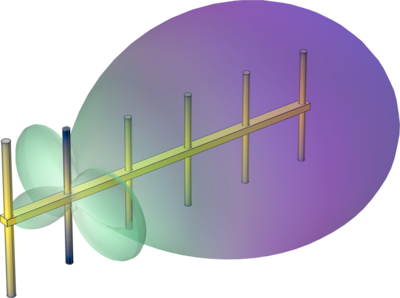
The Yagi–Uda antenna is designed for a specific Wi-Fi band and can reduce eavesdropping by directing signals with the help of directors. This antenna consists of one uniformly spaced reflector and four directors. Simulated results show a maximum 10 dBi gain and a front-to-back ratio of ... Per saperne di più
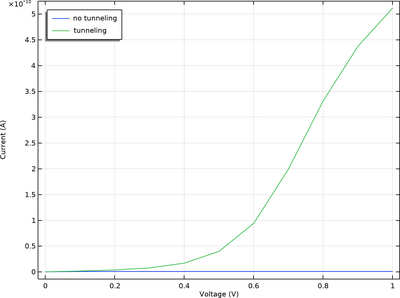
This model shows how to model a simple Metal–Insulator–Metal (MIM) diode. The two metal electrodes are defined on each side using the Metal Contact feature. Two studies were performed: one without quantum tunneling across the potential barrier and the other including it, using the WKB ... Per saperne di più
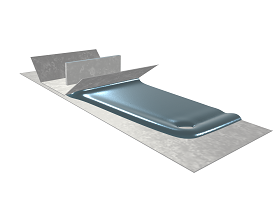
This is a tutorial of a slot die coating process in 3D where the channel is obstructed. The example uses a two-phase flow phase-field method with a non-Newtonian power-law fluid. The effects on the film thickness of the channel obstruction can clearly be seen. Per saperne di più
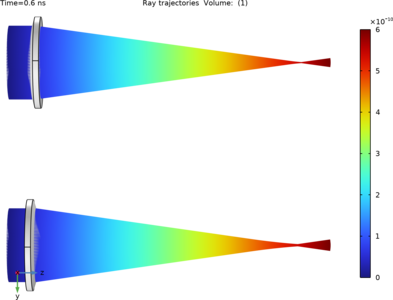
Light collimation or focusing is a basic task often needed when working with lasers in the lab where singlets are used due to their simplicity. If a plano-convex lens is used for the task, there is a correct lens orientation that minimizes aberrations. A useful rule-of-thumb is to ... Per saperne di più
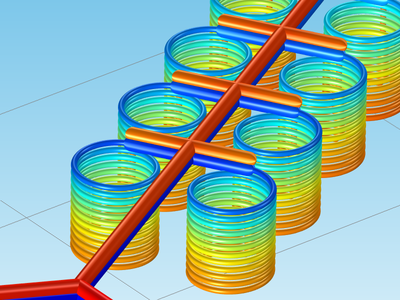
Ponds and lakes can serve as thermal reservoirs in geothermal heating applications. In this example, fluid circulates underwater through polyethylene piping in a closed system. The pipes are coiled in a slinky shape and grouped onto sleds. The Non-isothermal Pipe Flow interface sets up ... Per saperne di più
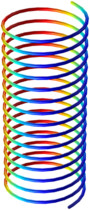
This model computes the trajectory of an ion in a uniform magnetic field using the Newtonian, Lagrangian and Hamiltonian formulations available in the Mathematical Particle Tracing interface. Per saperne di più
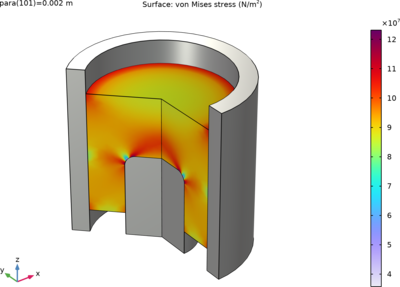
The fabrication of a cup through powder compaction is simulated in this tutorial model. The powder compaction process is becoming common in the manufacturing industry, due to its potential for producing components of complex shape and high strength. Combining the Fleck–Kuhn–McMeeking ... Per saperne di più
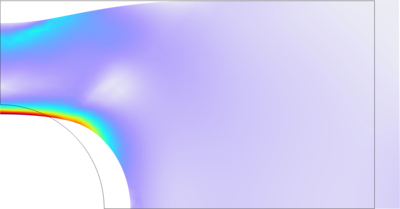
This example shows the analysis of a perforated plate loaded into the plastic regime. Part of the example is a benchmark, which you can find in section 7.10 of The Finite Element Method by O.C. Zienkiewicz. The unloading of the plate and residual stresses are also studied. In a second ... Per saperne di più
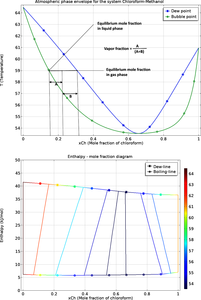
This is a demonstration of how to use the thermodynamics functionality in the COMSOL Multiphysics® software to make flash calculations. A flash calculation is an equilibrium calculation of a system where several species and phases are present at the same time. The system in ... Per saperne di più
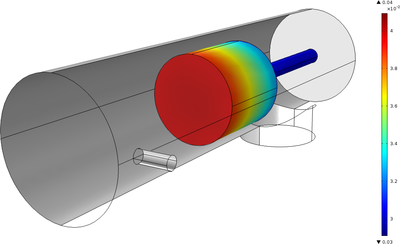
Chemical vapor deposition (CVD) is a process often used in the semiconductor industry to grow layers of high-purity solid material on top of a wafer substrate. CVD is achieved using many different techniques and across a range of pressures from atmospheric to ultrahigh vacuum (UHV/CVD). ... Per saperne di più


