
La Galleria delle Applicazioni raccoglie un'ampia varietà di tutorial e di app dimostrative realizzati con COMSOL Multiphysics in diversi ambiti applicativi, inclusi quelli elettrico, meccanico, fluidico e chimico. E' possibile scaricare i file dei modelli e delle app demo pronti all'uso e le istruzioni step-by-step per costruirli, e utilizzarli come punto di partenza per le proprie simulazioni.
Lo strumento di Ricerca Rapida permette di trovare i modelli che si riferiscono alla propria area di interesse.
Si noti che molti degli esempi qui presentati sono accessibili anche tramite le Librerie delle Applicazioni incorporate nel software COMSOL Multiphysics® e disponibili dal menu File.
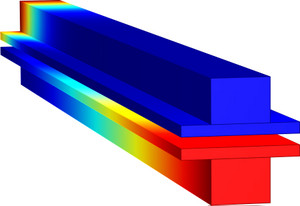
This model presents a study of the current density distribution in a solid oxide fuel cell (SOFC). The model includes the full coupling between the mass balances at the anode and cathode, the momentum balances in the gas channels, the gas flow in the porous electrodes, the balance of ... Per saperne di più
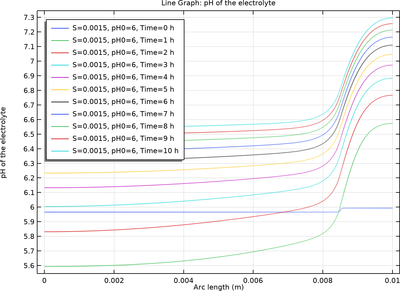
The model simulates atmospheric corrosion of a galvanic couple, comprising of an Al-Co-Ce metallic coating and an aluminum alloy, which is in contact with electrolyte film of 100 micrometer thickness. The corrosion inhibitors are released from the metallic coating and are transported ... Per saperne di più
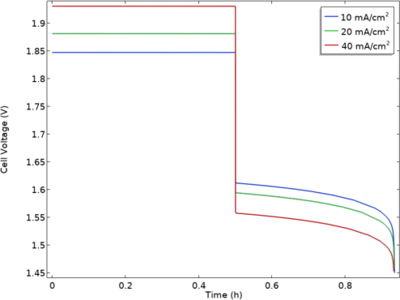
The zinc bromine redox flow battery is an electrochemical energy storage technology suitable for stationary applications. Compared to other flow battery chemistries, the Zn-Br cell potentially features lower cost, higher energy densities and better energy efficiencies. In the cell ... Per saperne di più
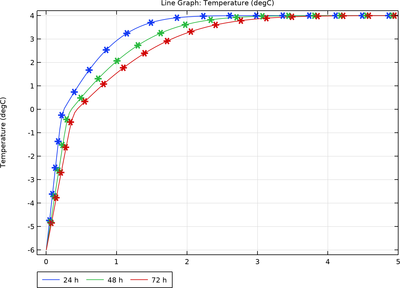
In this example, a heat-conduction problem with phase change in a porous material is solved, and the results are compared with the analytical solution, also known as the Lunardini solution. This is the first benchmark case from the InterFrost project, which was initiated to compare ... Per saperne di più
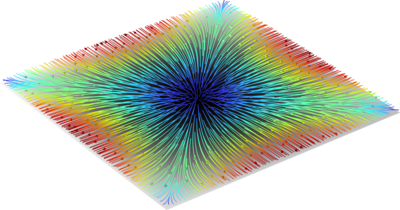
This example describes how to simulate the flow of a thin film of fluid in the gap between two rectangular plates, one of them with a porous facing, when the fluid is squeezed as a consequence of the relative motion between the plates. The model accounts for the ingress and egress of ... Per saperne di più

Impedance tubes are used for estimating the surface impedance of various samples, for example, a layer of porous material used for sound insulation. This model shows how the five material parameters of the Johnson-Champoux-Allard model can be estimated from the pressure at two ... Per saperne di più
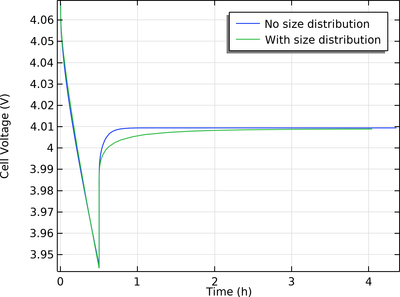
Battery electrodes featuring large heterogeneities in terms of particle sizes may sometimes not be adequately described by homogenized models using one single particle size only. As an alternative to adding multiple instances of the Additional Porous Electrode material node, this ... Per saperne di più
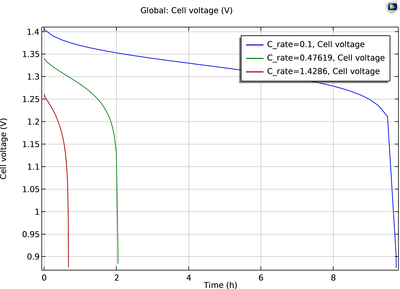
This model reproduces the NiCd battery model and the results presented in De Vidts' and White's paper from 1995. Ref: P. De Vidts, R. E. White, “Mathematical Modeling of a Nickel-Cadmium Cell: Proton Diffusion in the Nickel Electrode”, J. Electrochem. Soc, Vol. 142, No. 5, May 1995. Per saperne di più

This example models a solid oxide electrolyzer cell wherein water vapor is reduced to form hydrogen gas on the cathode, and oxygen gas is evolved on the anode. The current distribution in the cell is coupled to the cathode mass transfer of hydrogen and water and momentum transport. Two ... Per saperne di più
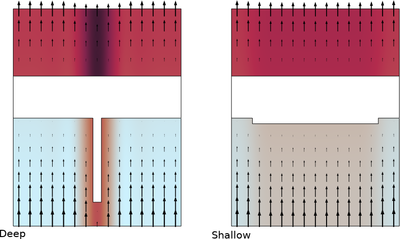
The copper current collector on negative graphite electrodes in lithium-ion batteries have been seen to dissolve at over discharge. This can be a safety concern as the dissolution damages the current collector irreversibly and dissolved copper ions can redeposit and form dendrites. ... Per saperne di più


