
La Galleria delle Applicazioni raccoglie un'ampia varietà di tutorial e di app dimostrative realizzati con COMSOL Multiphysics in diversi ambiti applicativi, inclusi quelli elettrico, meccanico, fluidico e chimico. E' possibile scaricare i file dei modelli e delle app demo pronti all'uso e le istruzioni step-by-step per costruirli, e utilizzarli come punto di partenza per le proprie simulazioni.
Lo strumento di Ricerca Rapida permette di trovare i modelli che si riferiscono alla propria area di interesse.
Si noti che molti degli esempi qui presentati sono accessibili anche tramite le Librerie delle Applicazioni incorporate nel software COMSOL Multiphysics® e disponibili dal menu File.
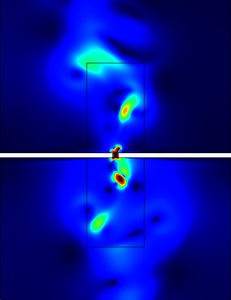
In many applications, acoustic waves interact with surfaces that have small perforations or slits. This can be in muffler systems; in soundproofing structures; in liners for noise suppression in jet engines; or in grilles and meshes in front of, for example, miniature speakers in mobile ... Per saperne di più
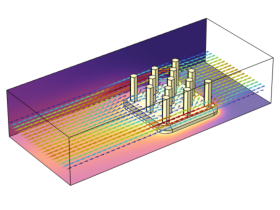
This model is intended as a first introduction to simulations of fluid flow and conjugate heat transfer. It shows you how to: Draw an air box around a device in order to model convective cooling in this box, set a total heat flux on a boundary using automatic area computation, and ... Per saperne di più

In COMSOL Multiphysics, you can import mesh and interpolation data created by other software for use in your simulations. You can also export data created in COMSOL Multiphysics to use in other COMSOL models and applications as well as other software. This document and accompanying ... Per saperne di più
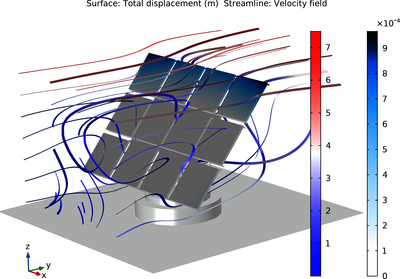
This model exemplifies the analysis of strong wind flow around a solar panel and the corresponding structural displacement due to the wind's load. The solar panel is located in an array of equally spaced identical panels, which allows for the assumption that the periodic flow conditions ... Per saperne di più
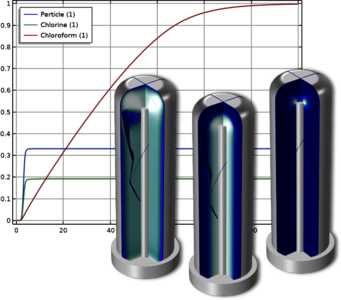
This example illustrates how to model the transport of different contaminants through a ceramic water filter candle with an activated carbon core. These types of water filters can be found in table top gravity filters, as well as attached to the faucet or as part of a larger reverse ... Per saperne di più

A plane TE-polarized electromagnetic wave is incident on a gold nanoparticle on a dielectric substrate. The absorption and scattering cross-sections of the particle are computed for a few different polar and azimuthal angles of incidence. The model first computes a background field from ... Per saperne di più
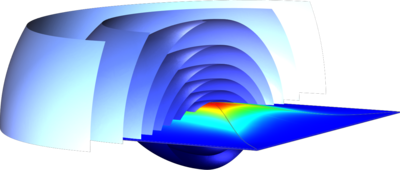
This model analyzes a piezoelectric microelectromechanical system (MEMS) speaker. The speaker, composed of four triangular membranes, uses a layer of lead zirconate titanate (PZT) material with two electrodes on top of a silicon layer as actuators. The triangular membranes are separated ... Per saperne di più

This example models a solid oxide electrolyzer cell wherein water vapor is reduced to form hydrogen gas on the cathode, and oxygen gas is evolved on the anode. The current distribution in the cell is coupled to the cathode mass transfer of hydrogen and water and momentum transport. Two ... Per saperne di più


