
La Galleria delle Applicazioni raccoglie un'ampia varietà di tutorial e di app dimostrative realizzati con COMSOL Multiphysics in diversi ambiti applicativi, inclusi quelli elettrico, meccanico, fluidico e chimico. E' possibile scaricare i file dei modelli e delle app demo pronti all'uso e le istruzioni step-by-step per costruirli, e utilizzarli come punto di partenza per le proprie simulazioni.
Lo strumento di Ricerca Rapida permette di trovare i modelli che si riferiscono alla propria area di interesse.
Si noti che molti degli esempi qui presentati sono accessibili anche tramite le Librerie delle Applicazioni incorporate nel software COMSOL Multiphysics® e disponibili dal menu File.
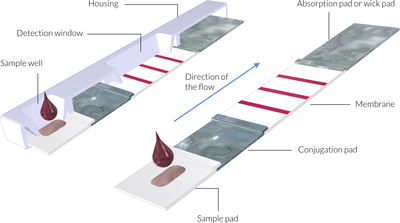
This example introduces three different models for a lateral flow assay for the detection of coronavirus antibodies. These models are as follows: 3D model for studying possible symmetries in the spreading of the liquid sample in the test strip. The 3D model shows that the flow is ... Per saperne di più

The primary defense of a submarine lies in its capacity to remain hidden during operation. As radio waves are strongly absorbed by seawater, sound navigation ranging, or sonar, is one of the main methods used for the detection of submarines. Sonar systems are also used for underwater ... Per saperne di più

Angle beam ultrasonic units are used for nondestructive testing (NDT) of solid objects, such as metal pipes. They are especially useful for detecting flaws in and around welding areas, such as pores, small cracks, lack of fusion, etc. Angle beam NDT is often used where the straight beam ... Per saperne di più

This example shows how to model a loudspeaker driver of the dynamic cone type, common for low and medium frequencies. The analysis is carried out in the frequency domain and thus represents the linear behavior of the driver. The model analysis includes the total electric impedance and ... Per saperne di più

This tutorial demonstrate the use of a Cross Grating feature in an échelle spectrograph. A cross grating is a periodic surface with two directions of periodicity. In this model the cross grating is used in high order in one direction and in first order in the orthogonal ("cross") ... Per saperne di più
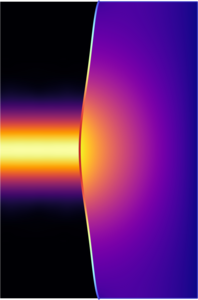
The thermal effects of a laser beam incident on a Semiconductor Saturable Absorber Mirror (SESAM) are simulated under a range of incident beam powers. This is done in two steps. The first study simulates the multiphysics combination of the saturated absorption of the beam on a SESAM, ... Per saperne di più

A 3D model is used to simulate the cooling of a bevel gear from an austenitic state. Phase material properties and phase transformation data are imported into the model. The final phase composition and the residual stress state are computed. Phenomena such as thermal strains, phase ... Per saperne di più

This example demonstrates how to use the Poroelasticity multiphysics coupling between the Solid Mechanics and Darcy's Law interfaces to model linear biphasic poroviscoelastic behavior of soft biological tissues. The implementation is verified using two numerical benchmarks from the ... Per saperne di più
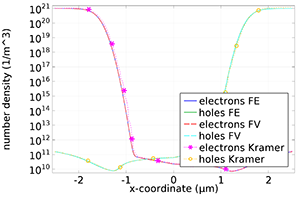
This simple benchmark model computes the potential and carrier concentrations for a one-dimensional p-n junction using both the finite element and finite volume methods. The results are compared with an equivalent device from the book, "Semiconductor Devices: A Simulation Approach," by ... Per saperne di più
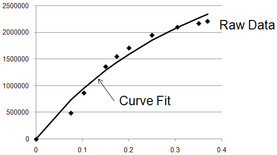
This presentation shows how to use the Optimization Module to fit a material model curve to experimental data. It is based on the hyperelastic Mooney-Rivlin material model example given in the Structural Mechanics users guide. Per saperne di più


