
La Galleria delle Applicazioni raccoglie un'ampia varietà di tutorial e di app dimostrative realizzati con COMSOL Multiphysics in diversi ambiti applicativi, inclusi quelli elettrico, meccanico, fluidico e chimico. E' possibile scaricare i file dei modelli e delle app demo pronti all'uso e le istruzioni step-by-step per costruirli, e utilizzarli come punto di partenza per le proprie simulazioni.
Lo strumento di Ricerca Rapida permette di trovare i modelli che si riferiscono alla propria area di interesse.
Si noti che molti degli esempi qui presentati sono accessibili anche tramite le Librerie delle Applicazioni incorporate nel software COMSOL Multiphysics® e disponibili dal menu File.
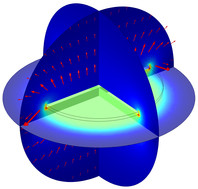
A typical capacitor is composed of two conductive objects with a dielectric in between them. A voltage difference applied between these objects results in an electric field between them. This electric field exists not just directly between the conductive objects, but extends some ... Per saperne di più
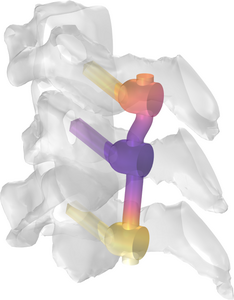
Tutorial example of the RF heating of passive conductive implants (rod and screws) inserted in three vertebrae during MRI. The RF fields are locally enhanced in the proximity of a passive conductive implant resulting in the heating of the portion of tissue facing the implant's surface. Per saperne di più
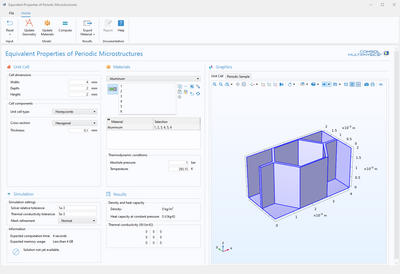
This app demonstrates the following: Visualization of a periodic structure from a unit cell Resetting some or all input parameters Export the resulting material properties as an MPH-file or an XML-file that can be imported to a COMSOL Multiphysics session Periodic microstructures are ... Per saperne di più
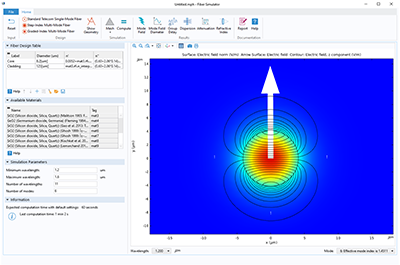
The transmission speed of optical waveguides is superior to microwave waveguides because optical devices have a much higher operating frequency than microwaves, enabling a far higher bandwidth. Single-mode step-index fibers are used for long-haul (even transoceanic) communication, ... Per saperne di più
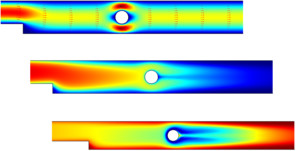
In this tutorial, the heat and mass transport equations are coupled to laminar flow in order to model exothermic reactions in a parallel plate reactor. It exemplifies how you can use COMSOL Multiphysics to systematically set up and solve increasingly sophisticated models using predefined ... Per saperne di più
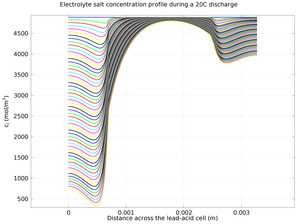
Lead-acid batteries are widely used as starting batteries for various traction applications such as cars and trucks and so forth. The reason for this is the fairly low cost in combination with the performance robustness for a broad range of operating conditions. However, one drawback of ... Per saperne di più
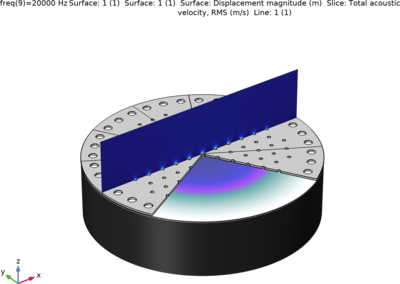
This is a model of a MEMS microphone solved in the frequency domain including the DC prestress effects. The model is set up using the Electromechanics multiphysics interface, Thermoviscous Acoustics, and Pressure Acoustics. The microphone consists of a perforated plate and a prestressed ... Per saperne di più

This tutorial demonstrate the use of a Cross Grating feature in an échelle spectrograph. A cross grating is a periodic surface with two directions of periodicity. In this model the cross grating is used in high order in one direction and in first order in the orthogonal ("cross") ... Per saperne di più
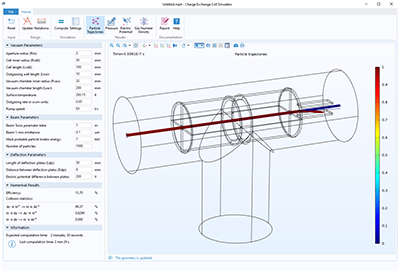
A charge exchange cell consists of a region of gas at an elevated pressure within a vacuum chamber. When an ion beam interacts with the higher-density gas, the ions undergo charge exchange reactions with the gas which then create energetic neutral particles. It is likely that only a ... Per saperne di più
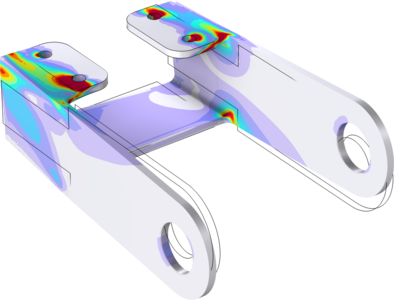
The bracket model tutorials are used as an introduction to the features and functionality within the Structural Mechanics Module. The following features are introduced: The following features are introduced: The fundamentals: static linear analysis Parametric study Including initial ... Per saperne di più


