
La Galleria delle Applicazioni raccoglie un'ampia varietà di tutorial e di app dimostrative realizzati con COMSOL Multiphysics in diversi ambiti applicativi, inclusi quelli elettrico, meccanico, fluidico e chimico. E' possibile scaricare i file dei modelli e delle app demo pronti all'uso e le istruzioni step-by-step per costruirli, e utilizzarli come punto di partenza per le proprie simulazioni.
Lo strumento di Ricerca Rapida permette di trovare i modelli che si riferiscono alla propria area di interesse.
Si noti che molti degli esempi qui presentati sono accessibili anche tramite le Librerie delle Applicazioni incorporate nel software COMSOL Multiphysics® e disponibili dal menu File.
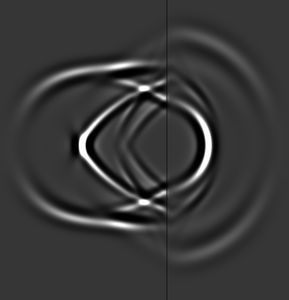
In this 2D tutorial, a test sample consists on one side of an isotropic material and on the other side of a heterogeneous anisotropic material (a transverse anisotropic zinc crystal). Elastic waves in the sample are excited by a point-like force. The model is solved with the Elastic ... Per saperne di più
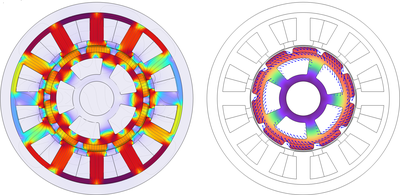
In this example, the coupling between Multibody Dynamics and Rotating Machinery, Magnetic for performing electromagnetic and mechanical analysis is demonstrated. A permanent magnet motor with 10 rotor poles and 12 stator slots is modelled in 2D. The magnets are attached to the ... Per saperne di più

This app demonstrates the following: Selecting predefined or user-defined materials User option to switch between laminar flow or turbulent flow Changing boundary conditions using methods Visualizing temperature dependent material properties as graph plots User option to set the solver ... Per saperne di più
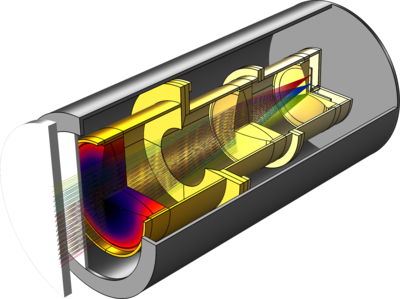
This model demonstrates an integrated structural-thermal-optical performance (STOP) analysis of an optical system. The Petzval Lens tutoral is used as the basis for this model, together with a simple barrel geometry The isothermal model performs a Parametric Sweep over several uniform ... Per saperne di più

An operational amplifier (op-amp) is a differential voltage amplifier with a wide range of applications in analog electronics. This tutorial models an op-amp connected to a feedback loop and a capacitive load. The op-amp is modeled as an equivalent linear subcircuit in the Electrical ... Per saperne di più
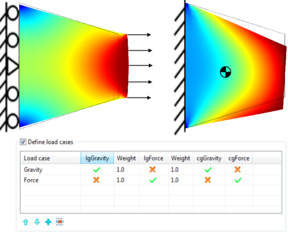
This example shows a 2D plane stress model of a thin tapered cantilever. Different boundary and load scenarios are examined. It is demonstrated how to apply and how to evaluate different load and constraint groups. Resulting stresses are compared to NAFEMS benchmark values and they are ... Per saperne di più

This example describes an array of heating tubes submerged in a vessel with fluid flow entering at the bottom. This is a multiphysics model because it involves fluid dynamics coupled with heat transfer. The pressure and the velocity field are the solution of the Navier-Stokes equations, ... Per saperne di più
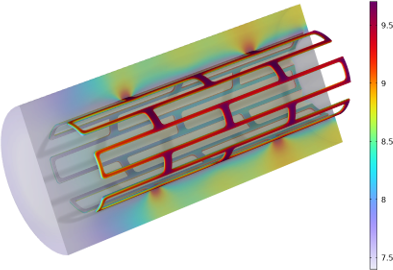
Biodegradable metallic biomaterials such as Magnesium (Mg) are gathering attention for biomedical applications due to their favorable properties. The present model simulates dissolution of a Mg stent in a blood vessel. Due to the circumferential symmetry, only one-twelfth of the actual ... Per saperne di più
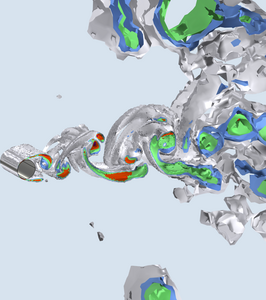
The model compare the two RANS models SST and SST-SAS for turbulent flow around a cylinder. The SST-SAS model resolve more transversal turbulent structures comared to the SST model. Per saperne di più
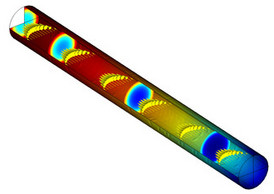
Tubular reactors are often used in continuous large-scale production, for example in the petroleum industry. One key design parameter is the conversion, or the amount of reactant that reacts to form the desired product. In order to achieve high conversion, process engineers optimize the ... Per saperne di più


