
La Galleria delle Applicazioni raccoglie un'ampia varietà di tutorial e di app dimostrative realizzati con COMSOL Multiphysics in diversi ambiti applicativi, inclusi quelli elettrico, meccanico, fluidico e chimico. E' possibile scaricare i file dei modelli e delle app demo pronti all'uso e le istruzioni step-by-step per costruirli, e utilizzarli come punto di partenza per le proprie simulazioni.
Lo strumento di Ricerca Rapida permette di trovare i modelli che si riferiscono alla propria area di interesse.
Si noti che molti degli esempi qui presentati sono accessibili anche tramite le Librerie delle Applicazioni incorporate nel software COMSOL Multiphysics® e disponibili dal menu File.

Zone electrophoresis (ZE) is an electrophoretic separation technique typically used for analyzing proteins, nucleic acids, and biopolymers. During the process, different species in a sample are transported in a continuous electrolyte buffer system, subject to a potential gradient. Due to ... Per saperne di più
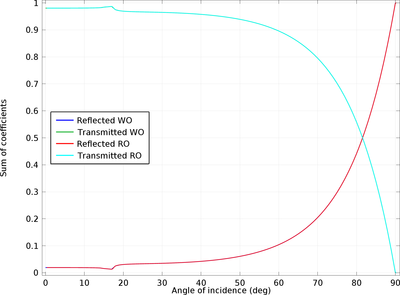
This model uses the Wave Optics Module and the Ray Optics module to model the propagation of rays through a diffraction grating at different angles of incidence. It uses the S-parameters computed by the Electromagnetic Waves, Frequency Domain interface on a unit cell of the grating to ... Per saperne di più
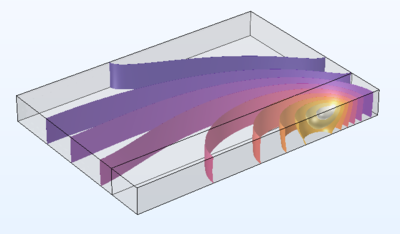
This model simulates arc welding of a titanium plate made from an alpha-beta titanium alloy. During a weld pass, the material experiences a thermal transient, including both heating and cooling. Phase transformations are modeled, and the evolution of the phase composition over time is ... Per saperne di più
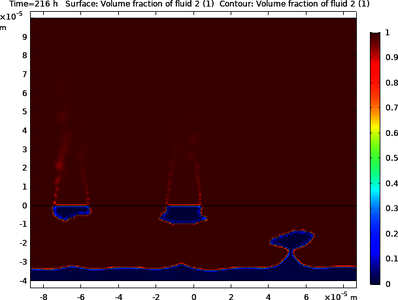
This example models galvanic corrosion between two different phases in a magnesium alloy for a representative cross-sectional microstructure configuration. The Phase Field interface is used here to model dissolution of a constituent phase leading to topological changes. The electrode ... Per saperne di più
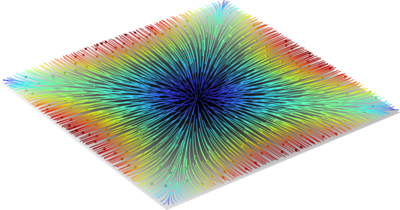
This example describes how to simulate the flow of a thin film of fluid in the gap between two rectangular plates, one of them with a porous facing, when the fluid is squeezed as a consequence of the relative motion between the plates. The model accounts for the ingress and egress of ... Per saperne di più

The first model describes the simultaneous flow of two immiscible fluids in porous media - here air displaces water in a multi-step inlet pressure experiment. We solve for the pressure and the degree saturation for the air and water within a representative volume and so track saturation ... Per saperne di più

The following model examines unsteady, incompressible flow past a long cylinder placed in a channel at right angle to the oncoming fluid. The cylinder is offset somewhat from the center of the flow to make the steady-state symmetrical flow unstable. The simulation time necessary for a ... Per saperne di più
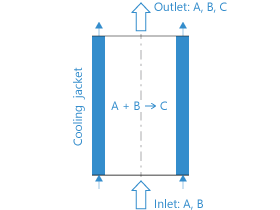
This alternative version of the Tubular Reactor app demonstrates how computational speed can be significantly increased by using a surrogate model instead of a full finite element model. A surrogate model is a simplified, computationally efficient approximation of a more complex and ... Per saperne di più
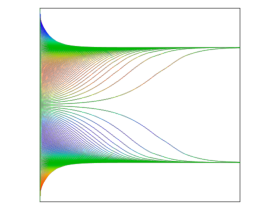
For more than 50 years, it has been known that neutrally buoyant particles in a flow channel tend to converge to specific locations in the channel cross section. For a cylindrical pipe, or two parallel planes carrying a Poiseuille flow, the equilibrium position is about 0.6 times the ... Per saperne di più

This example shows how to implement a stress dependent material model. The Young's modulus changes based on the stress value. Per saperne di più