
La Galleria delle Applicazioni raccoglie un'ampia varietà di tutorial e di app dimostrative realizzati con COMSOL Multiphysics in diversi ambiti applicativi, inclusi quelli elettrico, meccanico, fluidico e chimico. E' possibile scaricare i file dei modelli e delle app demo pronti all'uso e le istruzioni step-by-step per costruirli, e utilizzarli come punto di partenza per le proprie simulazioni.
Lo strumento di Ricerca Rapida permette di trovare i modelli che si riferiscono alla propria area di interesse.
Si noti che molti degli esempi qui presentati sono accessibili anche tramite le Librerie delle Applicazioni incorporate nel software COMSOL Multiphysics® e disponibili dal menu File.
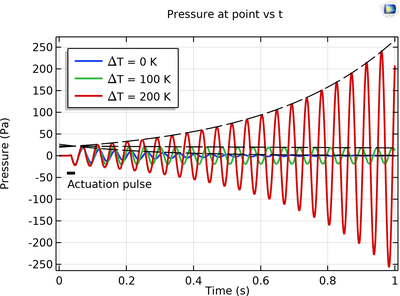
This is a model of a simple thermoacoustic engine that includes a thermal stack to convert thermal energy to acoustic energy. The model is set up using two approaches: 1) Using a linear perturbation (acoustic) approaches solving the fluid motion with the Thermoviscous Acoustics, ... Per saperne di più
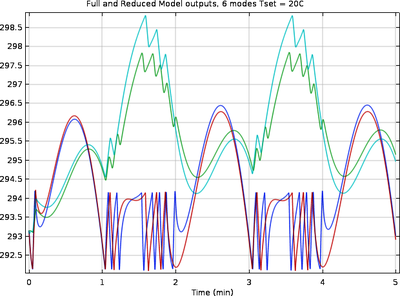
Large FEM simulations can be costly and, if repeated simulations are needed, it can be beneficial to use reduced-order models (ROMs). ROMs are typically valid only in the vicinity of their design conditions and have lower accuracy, but the simulation time is significantly shorter. The ... Per saperne di più

This space-dependent model describes a stirred semibatch reactor used for producing antibody–drug conjugates. The reactor is set up in 3D and the conjugation reactions, turbulent flow, and concentration fields are simulated as functions of time. The resulting yield and drug-to-antibody ... Per saperne di più
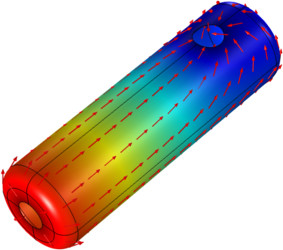
A goal for many applications is to predict physics in thin structures, such as shells, without modeling the thickness of the structure. This is because large aspect ratios can cause meshing and geometry analysis problems. This model demonstrates how to use the tangential derivative ... Per saperne di più

This example shows how to model tissue ablation through applying RF radiation. A more detailed description of the phenomenon and the modeling process can be seen in the blog post "Study Radiofrequency Tissue Ablation Using Simulation". Per saperne di più

Silicon carbide (SiC) epitaxial furnaces are a specialized equipment for the production and preparation of SiC epitaxial wafers. This example model demonstrates the process of preparing an SiC epitaxial wafer based on the physical vapor transport (PVT) method in a furnace. This involves ... Per saperne di più
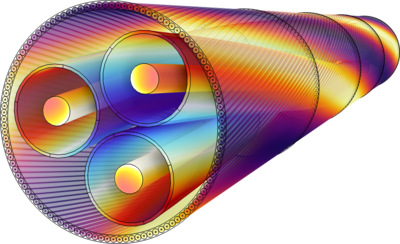
In this set of eight tutorial models and associated documentation, you can investigate the resistive, capacitive, inductive, and thermal properties of a standard three-core lead-sheathed XLPE HVAC submarine cable with twisted magnetic armor (500 mm2, 220 kV). The series includes a 2D, 2D ... Per saperne di più
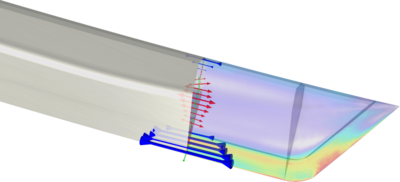
The katana is a legendary Japanese sword used by the samurai in olden days. Here, we present a simple model where we simulate a differential hardening process to explore some of the features of the katana. Learn more in this related blog post: Modeling the Differential Quenching of a ... Per saperne di più
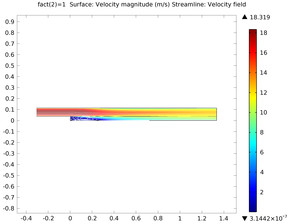
The backward facing step is an interesting case for studying the performance and solution strategy of a turbulence model. In this case, the flow is subjected to a sudden increase of cross-sectional area, resulting in a separation of flow starting at the point of expansion. Spatial ... Per saperne di più
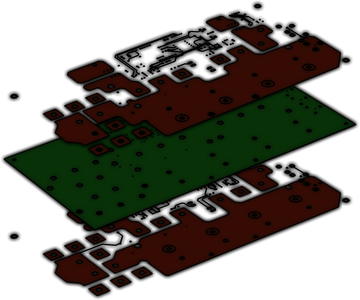
This tutorial model shows how to import data from an ODB++® archive to generate a geometry of a printed circuit board (PCB). Follow the instructions to learn how to remove small details from the geometry, create a mesh, and use automatically generated selections to define physics and ... Per saperne di più