
La Galleria delle Applicazioni raccoglie un'ampia varietà di tutorial e di app dimostrative realizzati con COMSOL Multiphysics in diversi ambiti applicativi, inclusi quelli elettrico, meccanico, fluidico e chimico. E' possibile scaricare i file dei modelli e delle app demo pronti all'uso e le istruzioni step-by-step per costruirli, e utilizzarli come punto di partenza per le proprie simulazioni.
Lo strumento di Ricerca Rapida permette di trovare i modelli che si riferiscono alla propria area di interesse.
Si noti che molti degli esempi qui presentati sono accessibili anche tramite le Librerie delle Applicazioni incorporate nel software COMSOL Multiphysics® e disponibili dal menu File.
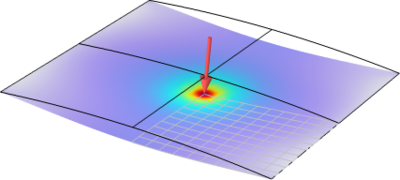
For slender structures, buckling is a catastrophic instability if the service load is above the critical limit. For such structures, it can be important to study the behavior of the structure beyond the critical buckling load, which is known as postbuckling analysis. Tracing the ... Per saperne di più
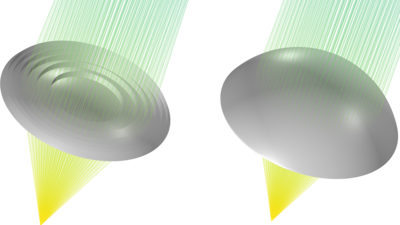
A Fresnel lens can be constructed from a plano-convex lens as a way to reduce the thickness. This model models the collimation property of a Fresnel lens and demonstrates the geometry operation of making a Fresnel lens from a plano-convex lens. Per saperne di più
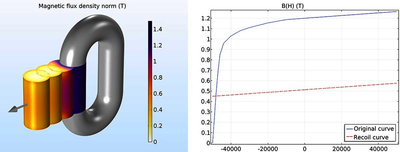
Soft permanent magnets like AlNiCo are easily demagnetized if handled incorrectly. This is a demonstration of how to model the self-demagnetization of a cylindrical AlNiCo magnet when moved out of its associated/protective magnetic circuit. The modeling is performed in three steps: The ... Per saperne di più
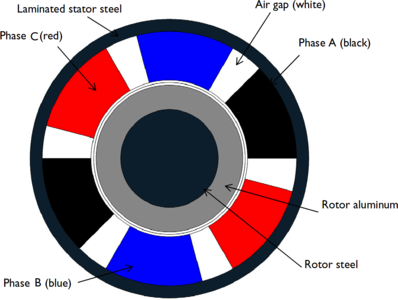
This is an example of a model of an induction motor in which the eddy currents are induced in the rotor by the time harmonic currents on the stator windings and the rotation of the rotor. In this example, we analyze the induction motor in 2D using the transient solver in the Rotating ... Per saperne di più
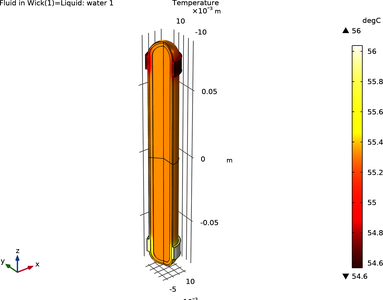
Heat pipes are designed to transfer heat efficiently through vaporization, mass transfer, and condensation of a working fluid. They are found in a wide variety of applications where thermal control is of importance, with cooling of electronics being a prominent example. Inside a heat ... Per saperne di più
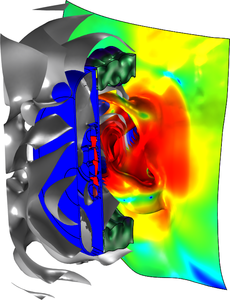
Headphones are closely coupled to the ear, and so it is not possible to measure their sensitivity in a classical acoustic free-field setup used for loudspeakers. The measurement requires the use of artificial heads and ears to accurately represent the usage conditions. This model shows ... Per saperne di più
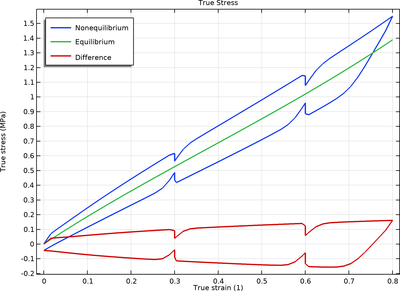
In this example, the Bergstrom–Boyce material model is used to capture the nonequilibrium behavior of carbon-black-filled chloroprene rubber under a strain history that alternates compression with relaxation. Results are verified against experimental and numerical results taken from ... Per saperne di più
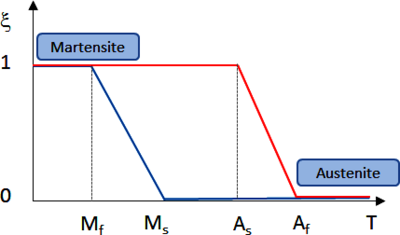
The model includes a compilation of benchmark examples included in the text book: Shape Memory Alloys: Modeling and Engineering Applications. D. Lagoudas Ed. Springer 2008. The model shows the thermomechanical properties of a NiTi alloy sample subjected to uniaxial tension-compression ... Per saperne di più
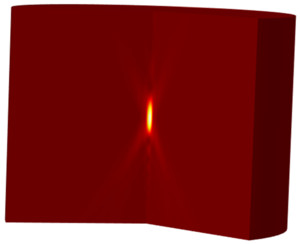
This tutorial shows how to model tissue heating induced by focused ultrasound. First, the stationary acoustic field in the water and the tissue are modeled to obtain the acoustic intensity distribution in the tissue. The absorbed acoustic energy is then calculated and used as the heat ... Per saperne di più
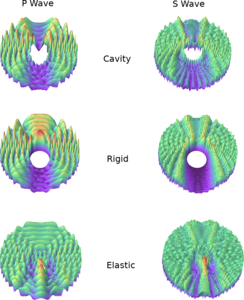
This model showcases how to solve for the scattered field when knowing the incident field for three different types of scatterer, that is, an infinitely rigid one, a cavity and an elastic inclusion. This formulation can be useful when the scatterer is in the far field of the source, so ... Per saperne di più


