
La Galleria delle Applicazioni raccoglie un'ampia varietà di tutorial e di app dimostrative realizzati con COMSOL Multiphysics in diversi ambiti applicativi, inclusi quelli elettrico, meccanico, fluidico e chimico. E' possibile scaricare i file dei modelli e delle app demo pronti all'uso e le istruzioni step-by-step per costruirli, e utilizzarli come punto di partenza per le proprie simulazioni.
Lo strumento di Ricerca Rapida permette di trovare i modelli che si riferiscono alla propria area di interesse.
Si noti che molti degli esempi qui presentati sono accessibili anche tramite le Librerie delle Applicazioni incorporate nel software COMSOL Multiphysics® e disponibili dal menu File.
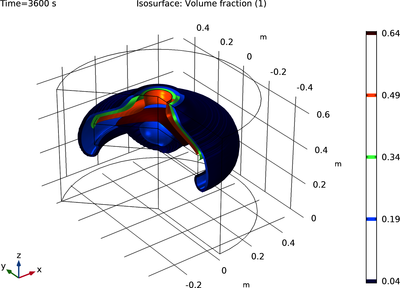
This example demonstrate two-phase flow in a porous medium which contains a low permeable lens. The heavier phase infiltrates the porous medium, so the low permeable lens is infiltrated only when a critical saturation at the outside is reached. Per saperne di più

This example is a benchmark problem for simulating phase change in porous media. It studies the melting process of an ice inclusion within porous media and therefore demonstrates how to couple Darcy's Law with the Heat Transfer in Porous Media interface including phase change. Per saperne di più
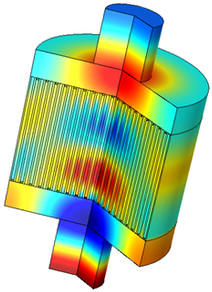
This is the model of the acoustics in a particulate-filter-like system. Real systems, like diesel particulate filters (DPFs), are designed to remove/filter soot (diesel particles) from the exhaust of diesel engine vehicles. The porous medium in such systems are typically structured with ... Per saperne di più
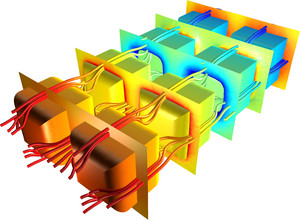
Transport through porous structures is usually treated using simplified homogeneous models with effective transport properties. This is in most cases a necessity, since the typical dimensions of the pores and particles making up the porous structure are several orders of magnitude ... Per saperne di più
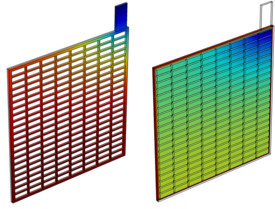
This 3D model example demonstrates the use of the Primary Current Distribution interface for modeling current distributions in electrochemical cells. In primary current distribution, the potential losses due to electrode kinetics and mass transport are assumed to be negligible, and ... Per saperne di più
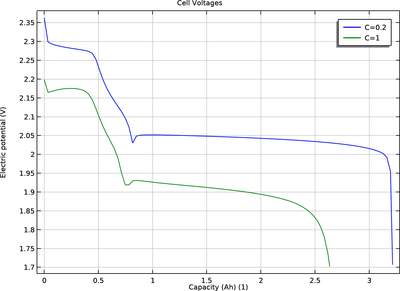
Lithium-sulfur (Li-S) batteries are used in niche applications with high demands for specific energy densities, which may be as high as 500-600 Wh/kg. The chemistry is fairly complex, since multiple polysulfide species participate in the various charge transfer reactions. The chemistry ... Per saperne di più

Modeling flow through realistic porous structures is difficult due to the complexity of the structure itself. Often, resolving the flow field in detail is not feasible; therefore, a macroscopic description of the pore scale structure, which utilize averaged quantities such as porosity ... Per saperne di più
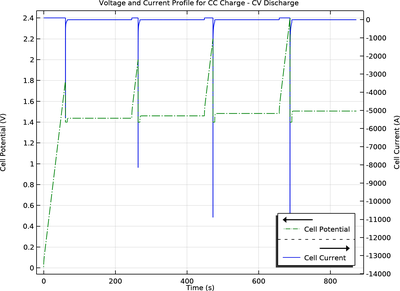
Electrochemical supercapacitors feature relatively higher energy densities than conventional capacitors. With several advantages, such as fast charging, long charge–discharge cycles, and broad operating temperature ranges, electrochemical supercapacitors have found wide applications in ... Per saperne di più

In this example water ponded in a ring on the ground moves into a relatively dry soil column and carries a chemical with it. As it moves through the variably saturated soil column, the chemical attaches to solid particles, slowing the solute transport relative to the water. Additionally ... Per saperne di più
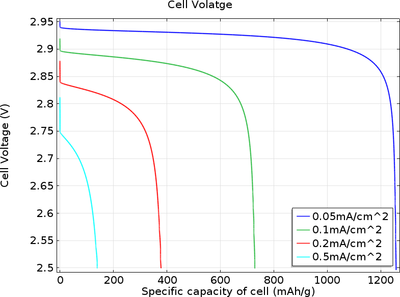
Rechargeable lithium-air batteries have recently attracted great interest mainly due to their high energy density. The theoretical value is about 11400 Wh/kg which is around 10 times greater than the lithium-ion batteries. In this tutorial, discharge of a lithium-air battery is ... Per saperne di più


