
La Galleria delle Applicazioni raccoglie un'ampia varietà di tutorial e di app dimostrative realizzati con COMSOL Multiphysics in diversi ambiti applicativi, inclusi quelli elettrico, meccanico, fluidico e chimico. E' possibile scaricare i file dei modelli e delle app demo pronti all'uso e le istruzioni step-by-step per costruirli, e utilizzarli come punto di partenza per le proprie simulazioni.
Lo strumento di Ricerca Rapida permette di trovare i modelli che si riferiscono alla propria area di interesse.
Si noti che molti degli esempi qui presentati sono accessibili anche tramite le Librerie delle Applicazioni incorporate nel software COMSOL Multiphysics® e disponibili dal menu File.
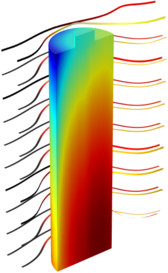
This example simulates the heat profile in an air-cooled cylindrical battery in 3d. The battery is placed in a matrix in a battery pack. The thermal model is coupled to a 1d-battery model that is used to generate a heat source in the active battery material. The model requires the ... Per saperne di più

Carbon corrosion is one of the important degradation mechanisms in a Polymer Electrolyte Membrane (PEM) fuel cells which predominantly occurs during start-up or shut down of the fuel cells. During carbon corrosion, carbon support to catalysts is compromised affecting the cell ... Per saperne di più
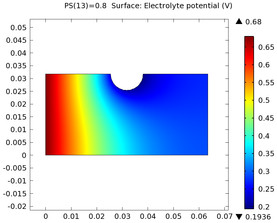
This example models cathodic protection of a steel reinforcing bar in concrete. Three different electrochemical reactions are considered on the steel surface. Charge and oxygen transport are modeled in the concrete domain, where the electrolyte conductivity and oxygen diffusivity depend ... Per saperne di più

This model utilizes the thermoviscous acoustic interface in a sub-model to obtain detailed results for the transfer impedance of a perforated plate (including the thermal and viscous losses). The impedance is in turn used as an internal impedance in a pressure acoustic model of a ... Per saperne di più
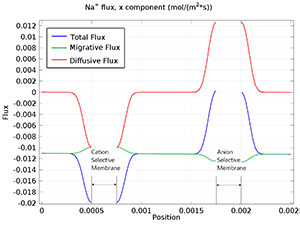
Electrodialysis is a separation process for electrolytes based on the use of electric fields and ion selective membranes. Some common applications of the electrodialysis process are: Desalination of process streams, effluents, and drinking water pH regulation in order to remove acids ... Per saperne di più

This model compares the solution to the model equations of a tubular reactor using Danckwerts inlet and outlet conditions. A second almost identical model is defined with extra inlet and outlet sections where no reactions occur. The concentration at the beginning of the inlet section is ... Per saperne di più
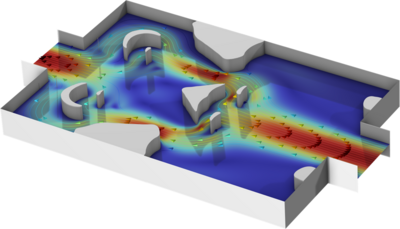
This model performs a topological optimization for a Tesla microvalve. A Tesla microvalve inhibits backwards flow using friction forces rather than moving parts. The design can be optimized by distributing a specific amount of material within the modeling domain. The goal is to maximize ... Per saperne di più

Copper electrowinning is the process of copper extraction from an electrolyte solution and its deposition at the cathode surface, by passing an external current through the electrolytic cell and using an insoluble anode. During the process, oxygen bubbles are generated at the anode ... Per saperne di più

The following example is a 2D tutorial model of a lithium-ion battery. The cell geometry is not based on a real application; it is only meant to demonstrate a 2D model setup. Per saperne di più

A simple model for groundwater contamination portrays a well that is bored into an aquifer. The aquifer consists of a partially saturated layer and a fully saturated layer. The model investigates how much of the contaminant ends up in the well after a contaminant is introduced in the ... Per saperne di più


