
La Galleria delle Applicazioni raccoglie un'ampia varietà di tutorial e di app dimostrative realizzati con COMSOL Multiphysics in diversi ambiti applicativi, inclusi quelli elettrico, meccanico, fluidico e chimico. E' possibile scaricare i file dei modelli e delle app demo pronti all'uso e le istruzioni step-by-step per costruirli, e utilizzarli come punto di partenza per le proprie simulazioni.
Lo strumento di Ricerca Rapida permette di trovare i modelli che si riferiscono alla propria area di interesse.
Si noti che molti degli esempi qui presentati sono accessibili anche tramite le Librerie delle Applicazioni incorporate nel software COMSOL Multiphysics® e disponibili dal menu File.
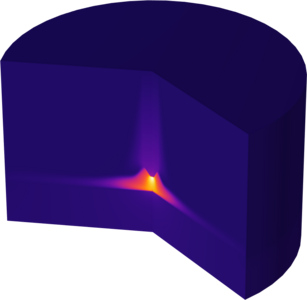
This example investigates the electrical and thermal characteristics of a welding argon arc created in a point-to-plane configuration. The discharge is assumed to be in local thermodynamic equilibrium. The electric arc is considered a conductive fluid medium and is modeled using a ... Per saperne di più
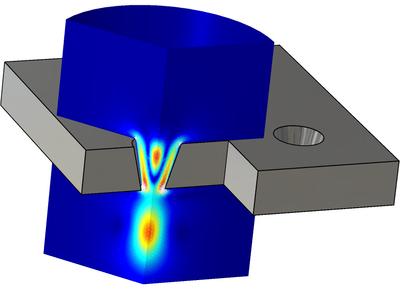
This model analyzes the nonlinear transfer impedance of a tapered orifice that can be part of a perforate or microperforated plate (MPP). The analysis is carried out for various degrees of tapering of the perforate and for a frequency range. A linear analysis is set up in the frequency ... Per saperne di più

This tutorial shows how to include local nonlinear effects when simulating the acoustics of an exponential horn. Nonlinear effects become important when an acoustic horn is used for high amplitude signaling. The Nonlinear Acoustics (Westervelt) Contributions feature available for the ... Per saperne di più

This example simulates Trichel pulses produced by negative corona discharge under a point-to-plate configuration. The electron density and the electric field are obtained, as well as the discharge current. The discharge current clearly shows the pulsating characters. Each current pulse ... Per saperne di più
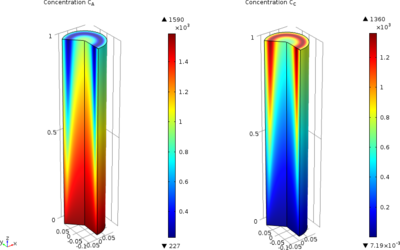
This application uses the Chemical Reaction Engineering Module to study an elementary, exothermic, irreversible reaction in a tubular reactor (liquid phase, laminar flow regime). To keep its temperature down, the reactor uses a cooling jacket with a constant coolant temperature. The ... Per saperne di più
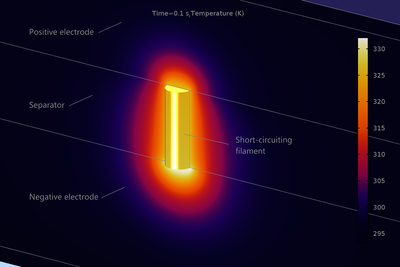
During an internal short circuit of a battery, the two electrode materials are internally and electronically interconnected, giving rise to high local current densities. Internal short circuits may occur in a lithium-ion battery due to, for instance, lithium dendrite formation or a ... Per saperne di più
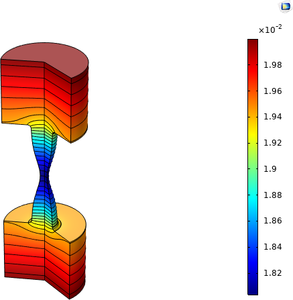
This model demonstrates the "butterfly" filling mechanism for copper electrodeposition in a Through-Hole (TH) via exposed to an electrolyte containing halide-suppressor additives. The Tertiary Current Distribution, Nernst Planck interface in combination with Deformed Geometry is used ... Per saperne di più
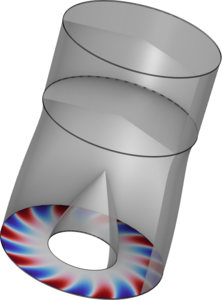
The acoustic field in a model of an axially symmetric lined aero-engine duct, based on modal sound transmission, is analyzed. The source is generated by a single mode excitation at a boundary. Sources and nonreflecting conditions are applied using port boundary conditions. The model ... Per saperne di più
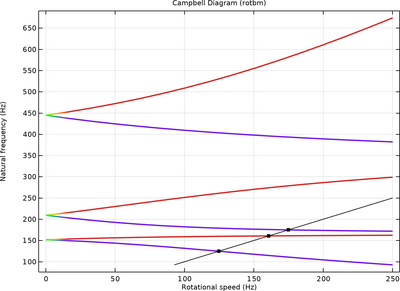
Different types of elements can be used for modeling a rotor, depending on the level of complexity and the type of the system being modeled. The modeling steps and representation of the results will vary with the type of idealization. In this tutorial model, an eigenfrequency analysis is ... Per saperne di più

The electrical insulation strength of gases is generally much lower than that of solids. Under normal operating conditions, electrical discharges—known as partial discharges—can occur in voids or cracks within a solid dielectric. This model simulates partial discharges in a spherical ... Per saperne di più


