
La Galleria delle Applicazioni raccoglie un'ampia varietà di tutorial e di app dimostrative realizzati con COMSOL Multiphysics in diversi ambiti applicativi, inclusi quelli elettrico, meccanico, fluidico e chimico. E' possibile scaricare i file dei modelli e delle app demo pronti all'uso e le istruzioni step-by-step per costruirli, e utilizzarli come punto di partenza per le proprie simulazioni.
Lo strumento di Ricerca Rapida permette di trovare i modelli che si riferiscono alla propria area di interesse.
Si noti che molti degli esempi qui presentati sono accessibili anche tramite le Librerie delle Applicazioni incorporate nel software COMSOL Multiphysics® e disponibili dal menu File.

Some positive electrode materials are known to deteriorate in overcharged lithium-ion battery cells. Predominantly, manganese containing electrode materials such as LMO and NMC can loose capacity due to manganese dissolving from the materials at overcharge. This decomposition is a ... Per saperne di più
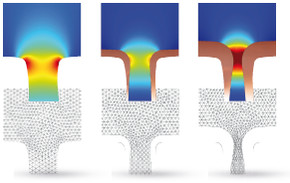
This model demonstrates the use of moving meshes in the application of copper electrodeposition on circuit boards. In these environments, the presence of cavities or 'trenches' are apparent. The model makes use of the Tertiary, Nernst-Planck interface for electrodeposition to keep track ... Per saperne di più
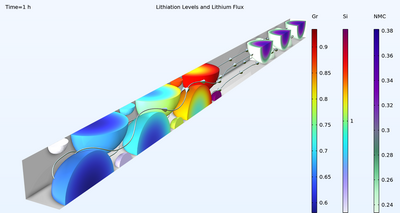
This model describes the behavior of a lithium-ion battery unit cell modeled using an idealized heterogeneous three-dimensional geometry. In contrast to the typical homogenized approach for describing porous electrodes, heterogeneous models define the actual shapes of the electrode ... Per saperne di più
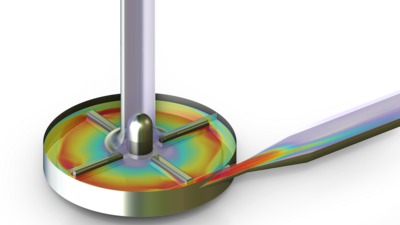
In this benchmark model for blood flow in a centrifugal pump, simulations are performed for several flow rates and pump speeds. The modeled geometry is taken from the FDA’s Computational Round Robin and the results are in good agreement with the experimental data. The computed shear ... Per saperne di più

This tutorial analyzes the resistive heating (Joule heating) of a busbar assembly designed to conduct a direct current from a current source to the anode in an electrolysis process. Per saperne di più
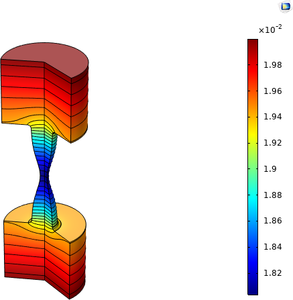
This model demonstrates the "butterfly" filling mechanism for copper electrodeposition in a Through-Hole (TH) via exposed to an electrolyte containing halide-suppressor additives. The Tertiary Current Distribution, Nernst Planck interface in combination with Deformed Geometry is used ... Per saperne di più
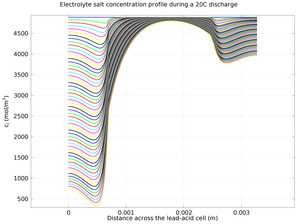
Lead-acid batteries are widely used as starting batteries for various traction applications such as cars and trucks and so forth. The reason for this is the fairly low cost in combination with the performance robustness for a broad range of operating conditions. However, one drawback of ... Per saperne di più
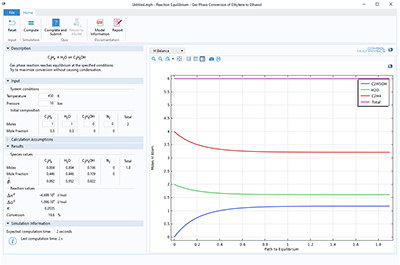
This app demonstrates the following: How an app can be used as a teaching tool An 8 question multiple choice quiz where the answers can be sent to the grader by email This app calculates the equilibrium compositions in gas phase conversion of ethylene to ethanol. It allows you to ... Per saperne di più

The present model example is based on Copper Deposition in a Trench model available in Electrodeposition Application Library. The nonuniform deposition along the trench surface leads to formation of a cavity/void. Since the Deformed Geometry interface cannot handle topological changes, ... Per saperne di più
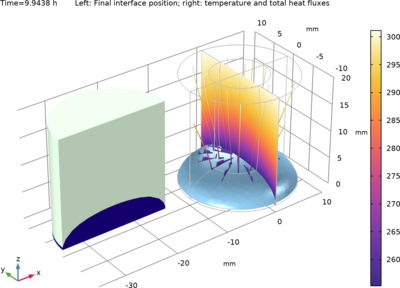
Freeze-drying, or lyophilization, is a process for drying heat-sensitive substances such as foods, blood plasma, and antibiotics. The wet substance is frozen and then, through sublimation, ice (or some other frozen solvent) is removed in the presence of a high vacuum. This example ... Per saperne di più


