
La Galleria delle Applicazioni raccoglie un'ampia varietà di tutorial e di app dimostrative realizzati con COMSOL Multiphysics in diversi ambiti applicativi, inclusi quelli elettrico, meccanico, fluidico e chimico. E' possibile scaricare i file dei modelli e delle app demo pronti all'uso e le istruzioni step-by-step per costruirli, e utilizzarli come punto di partenza per le proprie simulazioni.
Lo strumento di Ricerca Rapida permette di trovare i modelli che si riferiscono alla propria area di interesse.
Si noti che molti degli esempi qui presentati sono accessibili anche tramite le Librerie delle Applicazioni incorporate nel software COMSOL Multiphysics® e disponibili dal menu File.
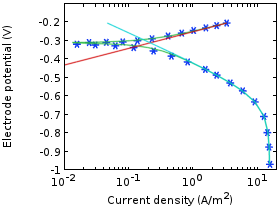
This tutorial shows how to use the Optimization interface to perform electrode kinetics parameter estimations based on polarization data. A zero-dimensional electrode polarization model is defined that separates kinetics expressions for the metal dissolution and the oxygen reduction ... Per saperne di più
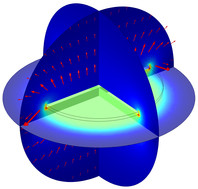
A typical capacitor is composed of two conductive objects with a dielectric in between them. A voltage difference applied between these objects results in an electric field between them. This electric field exists not just directly between the conductive objects, but extends some ... Per saperne di più
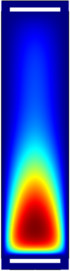
DC glow discharges in the low-pressure regime have long been used for gas lasers and fluorescent lamps. DC discharges are attractive to study because the solution is time independent. The 1D and 2D models show how to use the DC Discharge interface to set up an analysis of a positive ... Per saperne di più

This model simulates the electrohydrodynamic (EHD) flow of a dielectric liquid around a wire electrode positioned between two parallel flat-plate electrodes. The ion transport is described using the Poisson–Nernst–Planck equations, while fluid motion is governed by the Navier–Stokes ... Per saperne di più
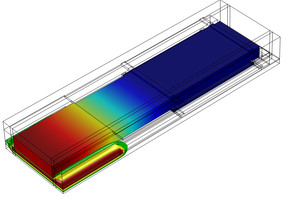
An electrostatically actuated MEMS resonator is simulated in the time and frequency domains. The device is driven by an AC + DC bias voltage applied across a parallel plate capacitor. The dependence of the resonant frequency on DC bias is assessed, and frequency domain and transient ... Per saperne di più
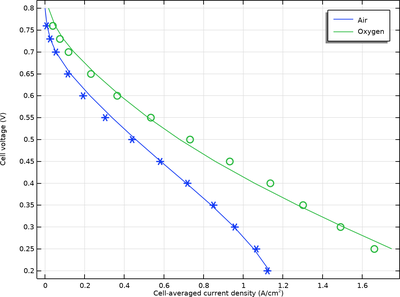
This tutorial demonstrates how to use stationary polarization data to perform parameter estimation of a polymer electrolyte membrane fuel cell (PEMFC) model. The model, defining a 5-layer membrane electrode assembly (MEA) is two-dimensional and includes electronic and ionic charge ... Per saperne di più
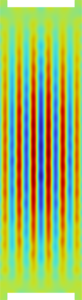
Lamb wave resonators are useful components for many radio-frequency applications. This tutorial shows how you model an aluminum nitride Lamb wave resonator and perform eigenfrequency and frequency-response analyses to characterize the device. Per saperne di più

This model calculates the DC breakdown voltage between parallel electrodes in air using a detailed charge transport approach. It is currently one-dimensional for simplicity but can be extended to other gases and dimensions. The results closely match experimental data found in the ... Per saperne di più
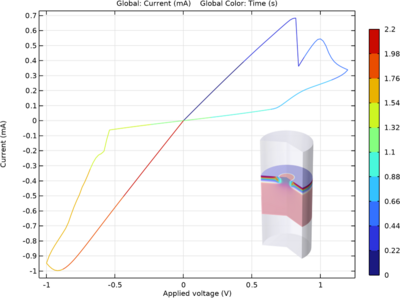
This model captures the dynamic resistive switching behavior of an oxide-based memristor. The device features a thin metal oxide layer sandwiched between two metal electrodes. When a voltage is applied, oxygen vacancies within the oxide layer migrate, acting as charge carriers and ... Per saperne di più
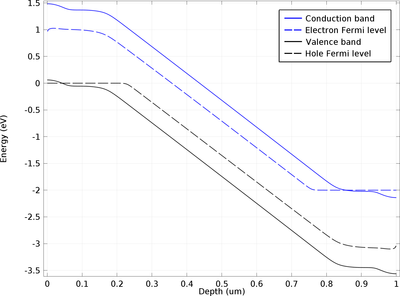
This simple model demonstrates how to use the Semiconductor Optoelectronics interfaces to model a simple GaAs PIN diode structure. Both the stimulated and spontaneous emission in the semiconductor are accounted for. The corresponding absorption of the light and the associated change in ... Per saperne di più


