
La Galleria delle Applicazioni raccoglie un'ampia varietà di tutorial e di app dimostrative realizzati con COMSOL Multiphysics in diversi ambiti applicativi, inclusi quelli elettrico, meccanico, fluidico e chimico. E' possibile scaricare i file dei modelli e delle app demo pronti all'uso e le istruzioni step-by-step per costruirli, e utilizzarli come punto di partenza per le proprie simulazioni.
Lo strumento di Ricerca Rapida permette di trovare i modelli che si riferiscono alla propria area di interesse.
Si noti che molti degli esempi qui presentati sono accessibili anche tramite le Librerie delle Applicazioni incorporate nel software COMSOL Multiphysics® e disponibili dal menu File.
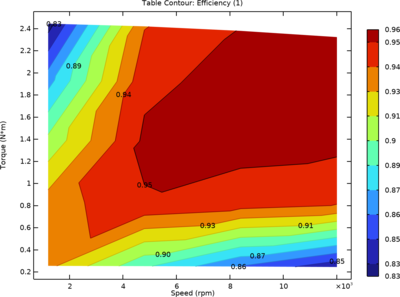
When electrical energy is converted into mechanical work in an electrical motor, the "wasted" energy that causes device heating is usually referred to as loss. The ratio of useful work to input energy, or the efficiency of the motor, is an important property for the overall energy ... Per saperne di più
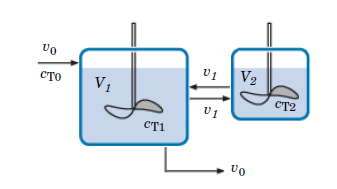
Real reactors can be modeled as combinations of ideal reactors. In this example the so-called "Dead zone model" is utilized. Two ideal CSTRs with interchange are set up to model the real reactor. One CSTR represents the highly agitated region and the other the less agitated region. For ... Per saperne di più

This example is a benchmark problem for simulating phase change in porous media. It studies the melting process of an ice inclusion within porous media and therefore demonstrates how to couple Darcy's Law with the Heat Transfer in Porous Media interface including phase change. Per saperne di più
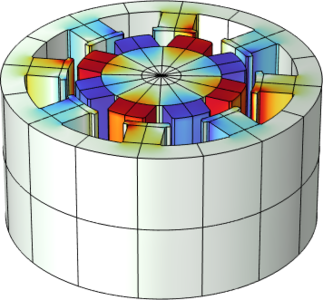
This application illustrates how to model an electric machine, such as a generator, motor, or drive, by exploiting its sector symmetry to reduce the size of the problem. The machine being studied is a simplified electric generator in 3D, based on the geometry used in the generator_2d ... Per saperne di più

This model shows how a flow model can be coupled to a process control mechanism. Controlling application parameters according to other application parameters is important within process engineering. Most control mechanisms use the data at a wall or an outlet to control inlet ... Per saperne di più

This example computes the power losses in a lithium-ion battery when exposed to high current pulses in a hybrid pulse power characterization (HPPC) test. Power loss contributions stemming from different phenomena are analyzed, as well as the total power losses pertaining to the ... Per saperne di più
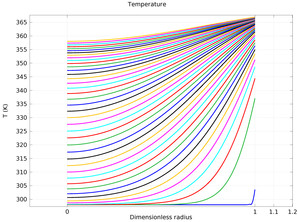
This model approximates 3D spherical transport using a 1D model. Many models of industrial-transport problems allow the assumption that the problem is spherically symmetric. This assumption is of great importance because it eliminates two space coordinates to result in a 1D problem that ... Per saperne di più

This example of a simple axisymmetric condenser microphone includes all the relevant physics and determines the microphone sensitivity as well as microphone capacitance for the specific simplified microphone geometry and material parameters. It solves a fully coupled multiphysics model ... Per saperne di più
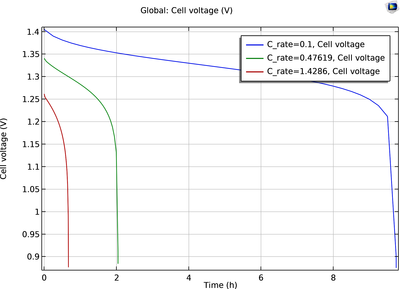
This model reproduces the NiCd battery model and the results presented in De Vidts' and White's paper from 1995. Ref: P. De Vidts, R. E. White, “Mathematical Modeling of a Nickel-Cadmium Cell: Proton Diffusion in the Nickel Electrode”, J. Electrochem. Soc, Vol. 142, No. 5, May 1995. Per saperne di più
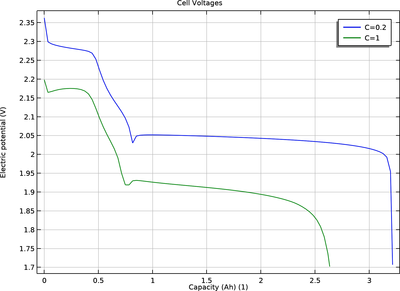
Lithium-sulfur (Li-S) batteries are used in niche applications with high demands for specific energy densities, which may be as high as 500-600 Wh/kg. The chemistry is fairly complex, since multiple polysulfide species participate in the various charge transfer reactions. The chemistry ... Per saperne di più


