
La Galleria delle Applicazioni raccoglie un'ampia varietà di tutorial e di app dimostrative realizzati con COMSOL Multiphysics in diversi ambiti applicativi, inclusi quelli elettrico, meccanico, fluidico e chimico. E' possibile scaricare i file dei modelli e delle app demo pronti all'uso e le istruzioni step-by-step per costruirli, e utilizzarli come punto di partenza per le proprie simulazioni.
Lo strumento di Ricerca Rapida permette di trovare i modelli che si riferiscono alla propria area di interesse.
Si noti che molti degli esempi qui presentati sono accessibili anche tramite le Librerie delle Applicazioni incorporate nel software COMSOL Multiphysics® e disponibili dal menu File.

These examples demonstrate using the Electrostatics, Boundary Elements interface, introduced in version 5.3 of the COMSOL Multiphysics® software. In the blog post associated with these files, "How to Create Electrostatics Models with Wires, Surfaces, and Solids", we demonstrate the pros ... Per saperne di più
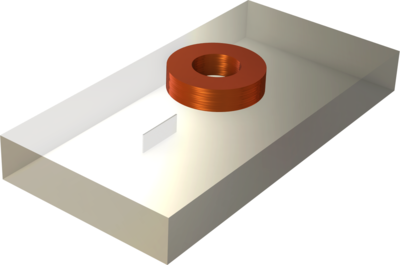
This model is a benchmark problem from TEAM workshop (problem 15 part I, see https://www.compumag.org/wp/team/). The model simulates the behavior of a coil as it scans a conductive plate containing a defect (a crack). The computed coil parameters, which include change in resistance and ... Per saperne di più

This model demonstrates how to solve an ordinary differential equation for the motion of a spacecraft about a planet. In addition to computing the path, it is possible to use several results presentation features to make interesting visualizations. For a full description of this model, ... Per saperne di più
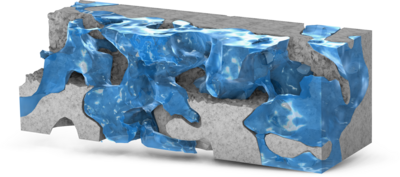
Digital Rock technology utilizes high-resolution imaging techniques, such as SEM and X-ray CT, to characterize the pore structures of rock cores. This approach enables pore-scale modeling of reservoir rocks, offering valuable insights into pore morphology, connectivity, and fluid ... Per saperne di più
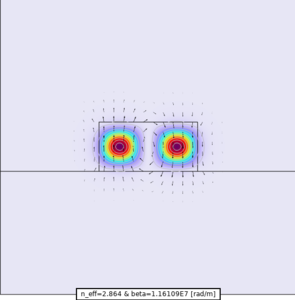
Mode analysis is a basic tool for a wide range of radiofrequency and wave optics calculations because it allows for the investigation of mode characteristics in complex waveguide structures. In this tutorial model, you can find two examples that demonstrate typical settings and best ... Per saperne di più

This model presents a way to compute projected area using the Surface-to-Surface Radiation interface of the Heat Transfer Module. By computing illuminated area from a set of directions on a discretized sphere, it is possible to interpolate the projected area onto any angle of incidence. ... Per saperne di più
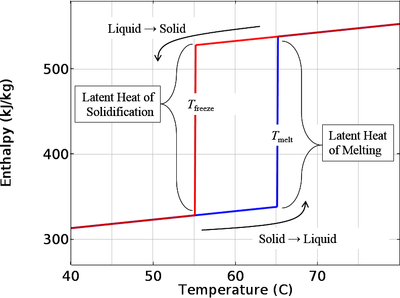
This example exemplifies how to model thermal phase change that is subject to hysteresis. A more detailed description of the phenomenon, and the modeling process, can be seen in the blog post "Thermal Modeling of Phase-Change Materials with Hysteresis" as well as: "How to Use State ... Per saperne di più
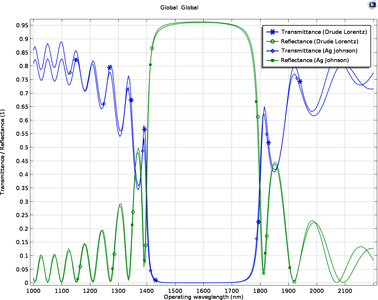
This example of a plasmonic waveguide filter shows that the waveguide rejects the electromagnetic radiation of the wavelength between 1.4 um and 1.6 um, but allows the rest of the wavelength. The silver material can be modeled using the Drude-Lorentz approximation, with ε∞ = 3.7, ωp = 13 ... Per saperne di più
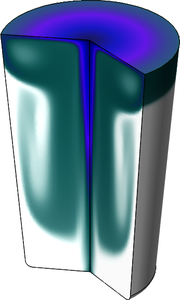
This example shows how to model carbonation, which is a type of sparging. Sparging is a mass transfer process between a gas and a liquid that is common in industry (such as beverage carbonation and photobioreactor applications) and at home (aquarium aeration). In the carbonation model, ... Per saperne di più

This a continuation of the permanent magnet motor model available here . In this model, an heat transfer analysis has been performed to compute the temperature rise for various stator current and rotor speed. A detailed analysis on torque, and losses in iron and copper have then been ... Per saperne di più


