
La Galleria delle Applicazioni raccoglie un'ampia varietà di tutorial e di app dimostrative realizzati con COMSOL Multiphysics in diversi ambiti applicativi, inclusi quelli elettrico, meccanico, fluidico e chimico. E' possibile scaricare i file dei modelli e delle app demo pronti all'uso e le istruzioni step-by-step per costruirli, e utilizzarli come punto di partenza per le proprie simulazioni.
Lo strumento di Ricerca Rapida permette di trovare i modelli che si riferiscono alla propria area di interesse.
Si noti che molti degli esempi qui presentati sono accessibili anche tramite le Librerie delle Applicazioni incorporate nel software COMSOL Multiphysics® e disponibili dal menu File.
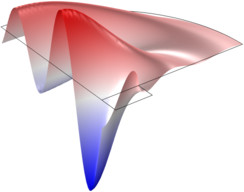
A piezoelectric transducer can be used either to transform an electric current to an acoustic pressure field or, the opposite, to produce an electric current from an acoustic field. These devices are generally useful for applications that require the generation of sound in air and ... Per saperne di più

How the open-circuit voltage (OCV) of a lithium-ion battery varies with the state of charge is governed by various physical properties such as the thermodynamics of the electrode reactions, the relative capacities of the electrode materials, and the amount of cyclable lithium, but also ... Per saperne di più
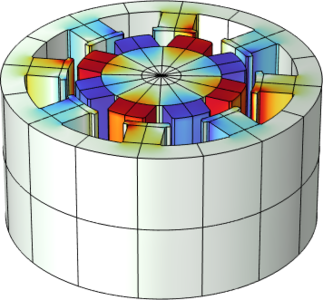
This application illustrates how to model an electric machine, such as a generator, motor, or drive, by exploiting its sector symmetry to reduce the size of the problem. The machine being studied is a simplified electric generator in 3D, based on the geometry used in the generator_2d ... Per saperne di più

When a conductive solid material moves through a static magnetic field, an eddy current is induced. The current that flows through the conductor, which is itself moving through the magnetic field, induces a Lorentz force back on the solid. Therefore, a conductive solid that is vibrating ... Per saperne di più
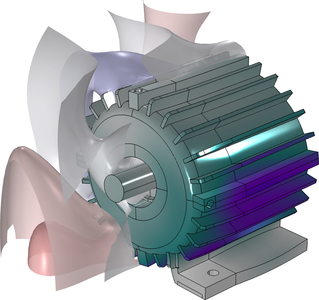
This model analyses the noise generated by an electric motor during its operation at different speeds of rotation. The type of electric motor analyzed, a permanent magnet synchronous motor (PMSM) uses permanent magnets in the rotor and a variable frequency current traveling through the ... Per saperne di più

In this tutorial, a PM motor with 10 rotor poles and 12 stator slots is modeled in 2D, to capture the torque ripple over an electrical period and map the volumetric loss density in the rotor and stator iron. Per saperne di più

This is a model of a moving-coil loudspeaker where a lumped parameter analogy represents the behavior of the electrical and mechanical speaker components. The Thiele-Small parameters (small-signal parameters) serve as input to the lumped model, which is represented by an Electric Circuit ... Per saperne di più

The mutual inductance and induced currents between a single turn primary and twenty turn secondary coil in a concentric coplanar arrangement is computed using a frequency domain model. Each turn of the secondary coil is modeled explicitly. The results are compared against analytic ... Per saperne di più
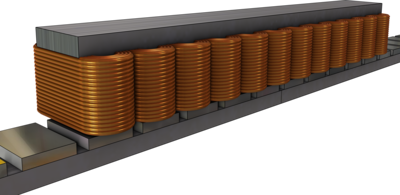
Linear motors are used in many applications in need of translational motion. Typical characteristics of linear motor designs are high precision or quick acceleration. This model investigates a synchronous motor with three-phase winding on the stationary part and permanent magnets on the ... Per saperne di più

A scanning electron microscope samples images by scanning a target with a high-energy beam of electrons. The subsequent electron interactions produce signals such as secondary and back-scattered electrons that contain information about the sample surface topography. Electromagnetic ... Per saperne di più


