
La Galleria delle Applicazioni raccoglie un'ampia varietà di tutorial e di app dimostrative realizzati con COMSOL Multiphysics in diversi ambiti applicativi, inclusi quelli elettrico, meccanico, fluidico e chimico. E' possibile scaricare i file dei modelli e delle app demo pronti all'uso e le istruzioni step-by-step per costruirli, e utilizzarli come punto di partenza per le proprie simulazioni.
Lo strumento di Ricerca Rapida permette di trovare i modelli che si riferiscono alla propria area di interesse.
Si noti che molti degli esempi qui presentati sono accessibili anche tramite le Librerie delle Applicazioni incorporate nel software COMSOL Multiphysics® e disponibili dal menu File.

During the design of a building, environmental issues have gained considerable influence in the entire project. One of the first concerns is to improve thermal performances. In this process, simulation software are key tools to model thermal losses and performances in the building. The ... Per saperne di più
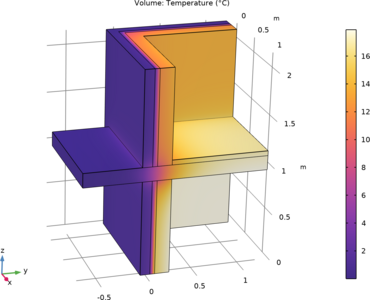
This model studies the heat conduction in a building structure separating two floors from the external environment. Four materials with distinct thermal conductivities k compose the structure. The exterior and interior boundaries are facing environments respectively at 0°C and 20°C. The ... Per saperne di più

This example of a simple axisymmetric condenser microphone includes all the relevant physics and determines the microphone sensitivity as well as microphone capacitance for the specific simplified microphone geometry and material parameters. It solves a fully coupled multiphysics model ... Per saperne di più

This model simulates a static analysis of heat conduction in a thin conductive shell. This is a benchmark model where the result is compared with a NAFEMS benchmark solution. Per saperne di più
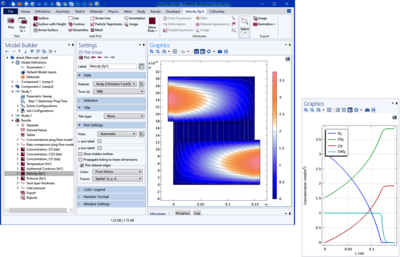
In this tutorial, a filter system for a diesel engine is modeled, including a soot layer development and oxidization. The build-up of the layer is held in check by both catalytic and non-catalytic reactions, where carbon is oxidized to carbon monoxide and carbon dioxide, which in turn ... Per saperne di più
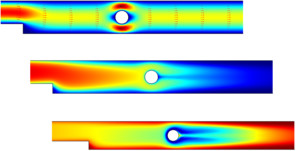
In this tutorial, the heat and mass transport equations are coupled to laminar flow in order to model exothermic reactions in a parallel plate reactor. It exemplifies how you can use COMSOL Multiphysics to systematically set up and solve increasingly sophisticated models using predefined ... Per saperne di più

This is a conceptual model illustrating how to couple fluid-structure interaction, heat transfer, and thermal expansion. A bimetallic strip in an air channel is heated so that it bends. After some time, an airflow with an inlet temperature which varies in time is introduced. As a ... Per saperne di più
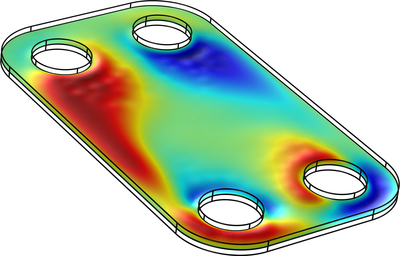
This model demonstrates how to use the built-in shape optimization functionality to improve the performance of a plate heat exchanger. The optimization reduces the path immediately in front of the inlets and outlets to increase the length of typical streamlines. This leads to a improved ... Per saperne di più
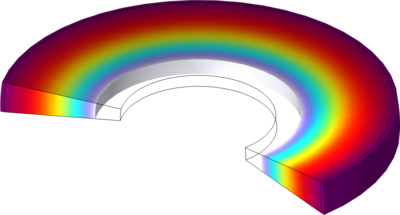
Creep is an inelastic time-dependent deformation which occurs when a material is subjected to stress at sufficiently high temperature, say 40% of the melting point or more. Experimental creep data (using constant stress and temperature) often display three different types of behavior ... Per saperne di più
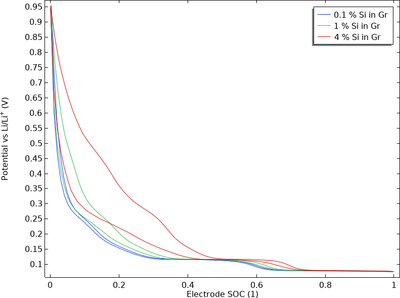
Due to its high capacity, silicon (Si) is often added to graphite in the negative electrode of lithium-ion batteries. Silicon–graphite blended electrodes may exhibit significant thermodynamic voltage hysteresis (“path dependence”) because the equilibrium potential of the lithium–silicon ... Per saperne di più