
La Galleria delle Applicazioni raccoglie un'ampia varietà di tutorial e di app dimostrative realizzati con COMSOL Multiphysics in diversi ambiti applicativi, inclusi quelli elettrico, meccanico, fluidico e chimico. E' possibile scaricare i file dei modelli e delle app demo pronti all'uso e le istruzioni step-by-step per costruirli, e utilizzarli come punto di partenza per le proprie simulazioni.
Lo strumento di Ricerca Rapida permette di trovare i modelli che si riferiscono alla propria area di interesse.
Si noti che molti degli esempi qui presentati sono accessibili anche tramite le Librerie delle Applicazioni incorporate nel software COMSOL Multiphysics® e disponibili dal menu File.
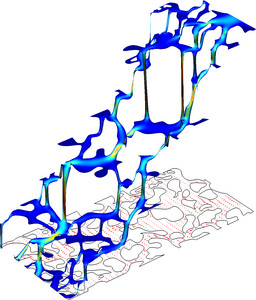
This non-conventional model of porous media flow utilizes creeping (Stokes) flow in the interstices of a porous media. The model comes from the pore-scale flow experiments conducted by Arturo Keller, Maria Auset, and Sanya Sirivithayapakorn of the University of California, Santa Barbara. ... Per saperne di più
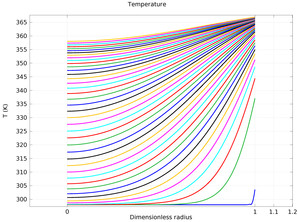
This model approximates 3D spherical transport using a 1D model. Many models of industrial-transport problems allow the assumption that the problem is spherically symmetric. This assumption is of great importance because it eliminates two space coordinates to result in a 1D problem that ... Per saperne di più

This example compares moisture transport within two types of anisotropic porous medium. The first component defines a layered structure. The structure alternates between layers with high and low moisture diffusivity. So the moisture spreads more easily along the layers than transversely. ... Per saperne di più
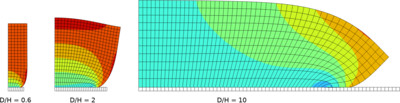
Polymer hydrogels consist of a crosslinked network of long-chained polymers that has imbibed a large number of solvent molecules. Such materials are used in many biomedical applications, such as targeted drug delivery, tissue engineering, and stimuli-sensitive actuators. This benchmark ... Per saperne di più
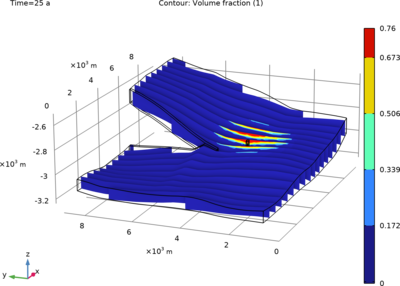
This example simulates the underground storage of CO2 in a part of the Johansen formation off the coast of Norway. The CO2 is injected using an injection well at a rate of 15 kg/s over a period of 25 years, after which the well is closed. The model is used to compute the spreading of CO2 ... Per saperne di più
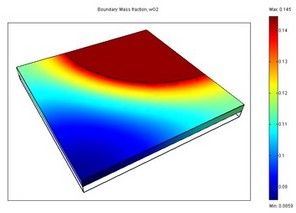
A stationary 3D model of a generic fuel cell cathode describing the mass fraction distribution of oxygen, water, and nitrogen, as well as the current distribution. The model uses Darcy's Law to describe convection, and couples this to Maxwell-Stefan diffusivities to also describe mass ... Per saperne di più

A slope stability analysis is performed and the Factor of Safety of the dam embankment is calculated by using the Shear Strength Reduction Technique. The pore pressure in the soil is computed based on Darcy’s law, and the Mohr–Coulomb constitutive model is used to describe the ... Per saperne di più

This example demonstrates how to use the Poroelasticity multiphysics coupling between the Solid Mechanics and Darcy's Law interfaces to model linear biphasic poroviscoelastic behavior of soft biological tissues. The implementation is verified using two numerical benchmarks from the ... Per saperne di più
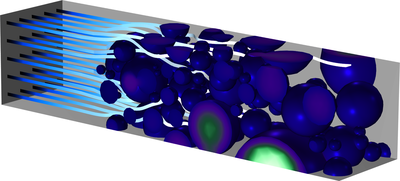
In this example, a heterogeneous NMC (Nickel-Manganese-Cobalt) electrode structure is generated from tomography data using a Model Method. Time-dependent discharge and electrochemical impedance spectroscopy (EIS) simulations are then made on the full 3D geometry. A solid mechanics ... Per saperne di più

The present model example is based on Copper Deposition in a Trench model available in Electrodeposition Application Library. The nonuniform deposition along the trench surface leads to formation of a cavity/void. Since the Deformed Geometry interface cannot handle topological changes, ... Per saperne di più


