
La Galleria delle Applicazioni raccoglie un'ampia varietà di tutorial e di app dimostrative realizzati con COMSOL Multiphysics in diversi ambiti applicativi, inclusi quelli elettrico, meccanico, fluidico e chimico. E' possibile scaricare i file dei modelli e delle app demo pronti all'uso e le istruzioni step-by-step per costruirli, e utilizzarli come punto di partenza per le proprie simulazioni.
Lo strumento di Ricerca Rapida permette di trovare i modelli che si riferiscono alla propria area di interesse.
Si noti che molti degli esempi qui presentati sono accessibili anche tramite le Librerie delle Applicazioni incorporate nel software COMSOL Multiphysics® e disponibili dal menu File.
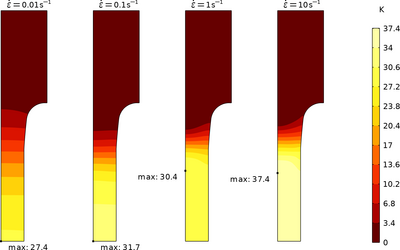
In this example, a tensile test is simulated at four different strain rates. The Johnson–Cook hardening law is used to model the strain rate dependency of the plastic hardening. The temperature distribution and thermal expansion caused by the heating generated by the plastic ... Per saperne di più
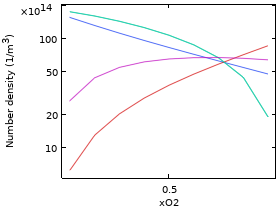
This tutorial model solves for an inductively coupled plasma reactor in a mixture of argon/oxygen. The model computes the fluid flow and gas heating. Important aspects and strategies for modeling electronegative discharges are discussed. Per saperne di più
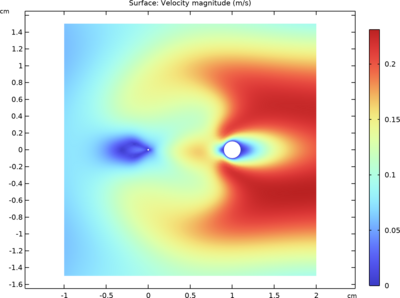
This model simulates the velocity of the ionic wind generated by a wire-to-wire corona discharge. Ionic wind, created by the movement of charged particles in an electric field, can be harnessed for various applications, including cooling electronic components and enhancing heat ... Per saperne di più
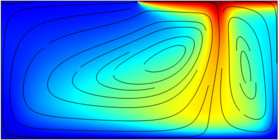
Density variations can initiate flow even in a still fluid. In earth systems, density variations can arise from naturally occurring salts, subsurface temperature changes, or migrating pollution. This buoyant or density-driven flow factors into fluid movement in salt-lake systems, saline ... Per saperne di più
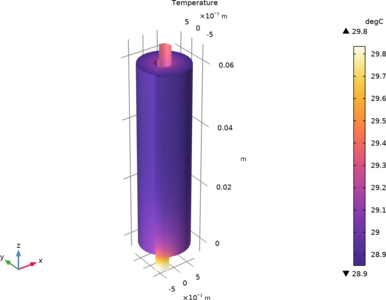
In a cylindrical or prismatic battery cell, the active layers, current collector metal foils and separators are wound into a “jelly roll”. Additional tabs (metal strips) are welded to the current collector foils in order to conduct the current to the exterior of the cell can. The ... Per saperne di più
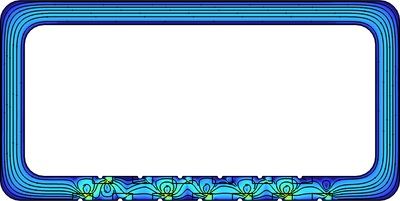
This tutorial uses a 2D model of an acoustically driven microfluidic pump. The acoustic microfluidic pump is driven by acoustic streaming originating from sharp edges in the microfluidic channel. It drives a flow around a closed microfluidic channel loop. The acoustic field is modeled ... Per saperne di più
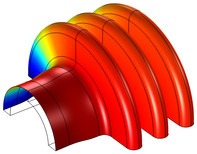
A cooling flange in a chemical process is used to cool the process fluid, which flows through the flange. The surrounding air cools the flange via natural convection. In the stationary model, the forced convection to the process fluid is modeled using a constant heat transfer ... Per saperne di più
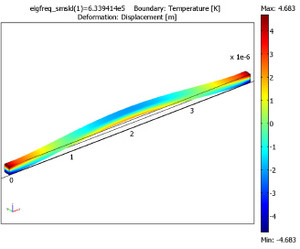
Thermoelastic damping, which arises when you subject a material to cyclic stress, is an important factor when designing MEMS resonators. The stress brings about deformation, where materials heat under compressive stress and cool under tensile stress. Thus, due to the resulting heat flux, ... Per saperne di più
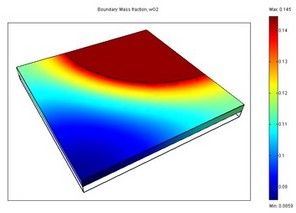
A stationary 3D model of a generic fuel cell cathode describing the mass fraction distribution of oxygen, water, and nitrogen, as well as the current distribution. The model uses Darcy's Law to describe convection, and couples this to Maxwell-Stefan diffusivities to also describe mass ... Per saperne di più
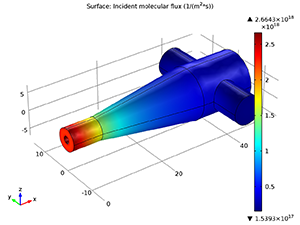
This model computes the transmission probability through an RF coupler using both the angular coefficient method available in the Free Molecular Flow interface and a Monte Carlo method using the Mathematical Particle Tracing interface. The computed transmission probability determined by ... Per saperne di più