
La Galleria delle Applicazioni raccoglie un'ampia varietà di tutorial e di app dimostrative realizzati con COMSOL Multiphysics in diversi ambiti applicativi, inclusi quelli elettrico, meccanico, fluidico e chimico. E' possibile scaricare i file dei modelli e delle app demo pronti all'uso e le istruzioni step-by-step per costruirli, e utilizzarli come punto di partenza per le proprie simulazioni.
Lo strumento di Ricerca Rapida permette di trovare i modelli che si riferiscono alla propria area di interesse.
Si noti che molti degli esempi qui presentati sono accessibili anche tramite le Librerie delle Applicazioni incorporate nel software COMSOL Multiphysics® e disponibili dal menu File.
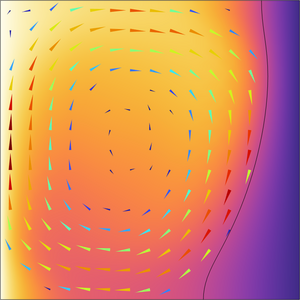
This example demonstrates how to model phase transition by a moving boundary interface according to the Stefan problem. A square cavity containing both solid and liquid tin is submitted to a temperature difference between left and right boundaries. Fluid and solid parts are solved in ... Per saperne di più
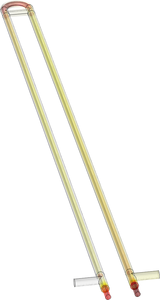
Double-pipe heat exchangers, with their typical U-turn shape, are one of the simplest and cheapest type of heat exchangers used in the chemical process industry. This example studies the cooling of hot oil (130°C) by a cool oil (60°C) entering in counter-current. As the oils flow ... Per saperne di più
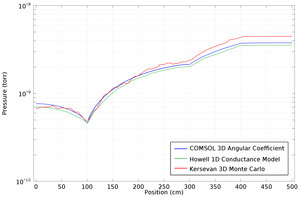
This benchmark model computes the pressure in a system of outgassing pipes with a high aspect ratio. The results are compared with a 1D simulation and a Monte-Carlo simulation of the same system from the literature. Per saperne di più
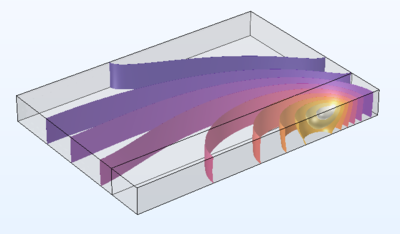
This model simulates arc welding of a titanium plate made from an alpha-beta titanium alloy. During a weld pass, the material experiences a thermal transient, including both heating and cooling. Phase transformations are modeled, and the evolution of the phase composition over time is ... Per saperne di più

Differentially pumped vacuum systems use a small orifice or tube to connect two parts of a vacuum system that are at very different pressures. Such systems are necessary when processes run at higher pressures and are monitored by detectors that require UHV for operation. In this model, ... Per saperne di più

This tutorial model illustrates how to calculate the pressure drop and initial flow rate in a pipe system connected to water tank. The Pipe Flow interface contains ready to use friction models accounting for the surface roughness of pipes as well as pressure losses in bends and valves. Per saperne di più
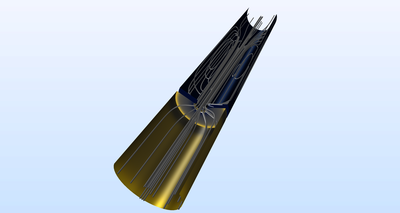
This example considers the turbulent flow of an oil-water suspension through an orifice. The oil droplets are broken up into smaller droplets by the turbulent stresses as the suspension passes through the orifice. The aim of this model is to track the distribution of droplet sizes. The ... Per saperne di più
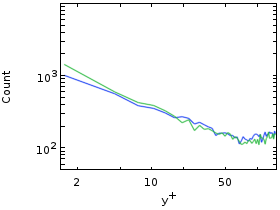
In this benchmark model, solid particles are released in a fully developed turbulent channel flow. The particles are subjected to a drag force that includes contributions from the fluid turbulence, implemented using a Continuous Random Walk (CRW) model. Because the turbulence in the ... Per saperne di più
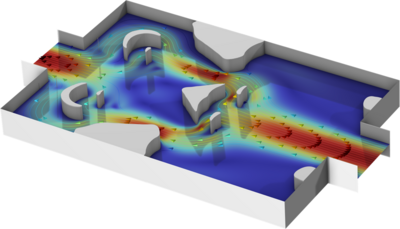
This model performs a topological optimization for a Tesla microvalve. A Tesla microvalve inhibits backwards flow using friction forces rather than moving parts. The design can be optimized by distributing a specific amount of material within the modeling domain. The goal is to maximize ... Per saperne di più
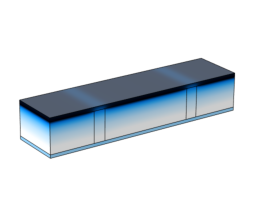
This 2D stationary model computes heat and moisture transport in a wall composed of different hygroscopic materials. A comparison with the Glaser method is given for the temperature and relative humidity solutions. The effect of the use of a vapor barrier is also investigated. Per saperne di più