
La Galleria delle Applicazioni raccoglie un'ampia varietà di tutorial e di app dimostrative realizzati con COMSOL Multiphysics in diversi ambiti applicativi, inclusi quelli elettrico, meccanico, fluidico e chimico. E' possibile scaricare i file dei modelli e delle app demo pronti all'uso e le istruzioni step-by-step per costruirli, e utilizzarli come punto di partenza per le proprie simulazioni.
Lo strumento di Ricerca Rapida permette di trovare i modelli che si riferiscono alla propria area di interesse.
Si noti che molti degli esempi qui presentati sono accessibili anche tramite le Librerie delle Applicazioni incorporate nel software COMSOL Multiphysics® e disponibili dal menu File.
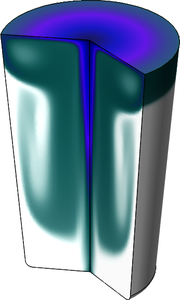
This example shows how to model carbonation, which is a type of sparging. Sparging is a mass transfer process between a gas and a liquid that is common in industry (such as beverage carbonation and photobioreactor applications) and at home (aquarium aeration). In the carbonation model, ... Per saperne di più
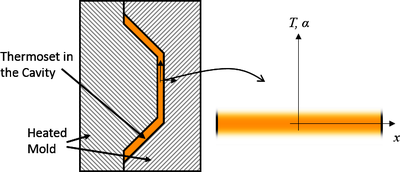
This example exemplifies how to model thermal curing using the base package of COMSOL Multiphysics. A more detailed description of the phenomenon and the modeling process can be seen in the blog post "Modeling the Thermal Curing Process". Per saperne di più
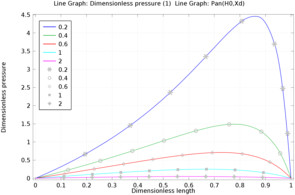
This benchmark model computes the load-carrying capacity of a one dimensional hydrodynamic slider bearing. The results are compared with analytic expressions obtained by solving the Reynolds equations directly in this simple case. Per saperne di più

This example models a small reverse osmosis water desalination unit. The unit consists of a spirally wound semi-permeable membrane through which the water is forced under high pressure. The membrane retains the salt, such that on the permeate side fresh water is produced and on the ... Per saperne di più
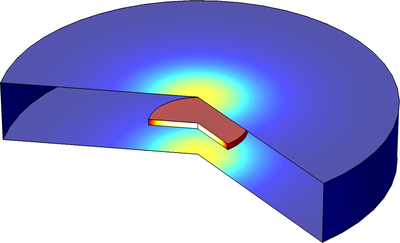
The flash method is widely used for measuring the thermal conductivity of a thin sample material that is about the size of a coin. The sample material is submitted to a laser pulse on one of its faces. In turn, the opposite face is heated up by around 1 K. As the pulse is uniform and ... Per saperne di più
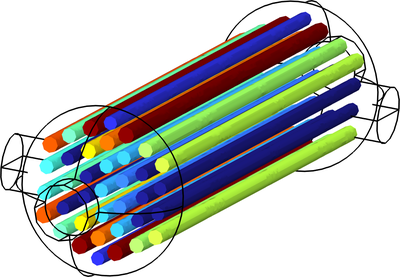
Commercial heat exchangers often feature a complex design. It is significantly easier to build a design with new CAD parameters than to build designs with novel topologies. This model demonstrate how to optimize the size and position of the tubes in a tube and shell heat exchanger. It is ... Per saperne di più

This tutorial model demonstrates the use of the multiphysics coupling feature Thermal Connection, Layered Shell, Edges. In this model, three layered shells are connected to heat domains by edges at difference locations related to the heat domains. The results obtained with the Heat ... Per saperne di più
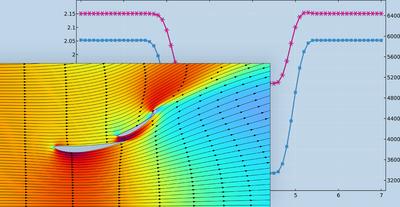
Active aerodynamics systems actuate components on a vehicle dynamically to improve fuel efficiency, optimize cooling, and enhance stability. A drag reduction system (DRS) is an example of an active aerodynamic technology, which is often used in Formula 1® cars to overtake other cars ... Per saperne di più

This model simulates a cylindrical furnace with isotropic scattering. It validates the use of the Discrete Ordinates Method for 2D axisymmetric cases, comparing the results with the highly accurate Monte Carlo method. The setup and reference Monte Carlo values are given in: R .P. Gupta, ... Per saperne di più
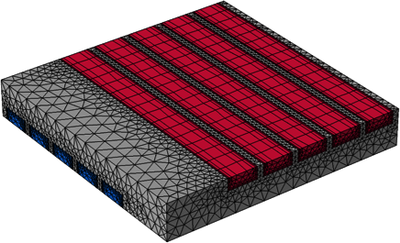
You can use assembly meshing to reduce the number of mesh elements in your model, which is especially useful for conjugate heat transfer simulation in cases where the fluid domains can be handled with swept mesh. These models demonstrate how to use form assembly and discontinuous meshes ... Per saperne di più


