
La Galleria delle Applicazioni raccoglie un'ampia varietà di tutorial e di app dimostrative realizzati con COMSOL Multiphysics in diversi ambiti applicativi, inclusi quelli elettrico, meccanico, fluidico e chimico. E' possibile scaricare i file dei modelli e delle app demo pronti all'uso e le istruzioni step-by-step per costruirli, e utilizzarli come punto di partenza per le proprie simulazioni.
Lo strumento di Ricerca Rapida permette di trovare i modelli che si riferiscono alla propria area di interesse.
Si noti che molti degli esempi qui presentati sono accessibili anche tramite le Librerie delle Applicazioni incorporate nel software COMSOL Multiphysics® e disponibili dal menu File.
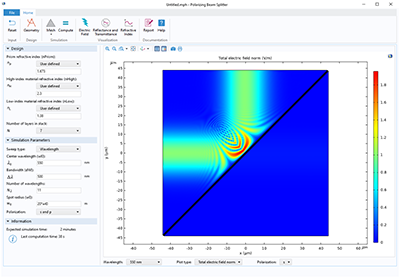
A Gaussian beam is incident on a 45-degree thin-film stack embedded in glass material prisms. The thin-film stack is designed from alternating high and low refractive index materials. The wave will be refracted at the Brewster angle at each internal interface. Thus, mainly p-polarized ... Per saperne di più
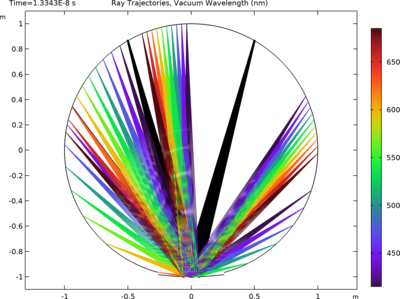
The Rowland circle is a circle of radius R that lies tangent to a concave curved diffraction grating of radius 2R. If the entrance slit of incoming light is positioned on this circle, then rays reflected by the grating will be focused at various points along the same circle based on ... Per saperne di più
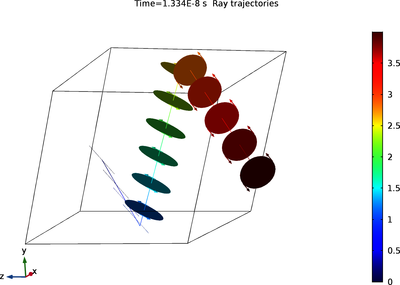
A Fresnel rhomb is a prism that uses total internal reflection to manipulate the polarization of light. In this example, light in the prism is internally reflected at an angle of incidence that induces a 45-degree phase delay between s- and p-polarized radiation. By subjecting the light ... Per saperne di più
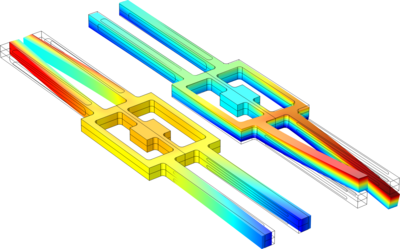
This model shows how to analyze a tuning fork based piezoelectric rate gyroscope. The reverse piezoelectric effect is used to drive an in-plane tuning fork mode. This mode is coupled to an out of plane mode by the Coriolis force and the resulting out of plane motion is sensed by the ... Per saperne di più

This model shows how to analyze a simple, cantilever based, piezoelectric energy harvester. A sinusoidal acceleration is applied to the energy harvester and the output power is evaluated as a function of frequency, load impedance and acceleration magnitude. Per saperne di più
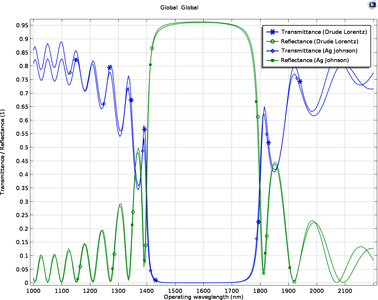
This example of a plasmonic waveguide filter shows that the waveguide rejects the electromagnetic radiation of the wavelength between 1.4 um and 1.6 um, but allows the rest of the wavelength. The silver material can be modeled using the Drude-Lorentz approximation, with ε∞ = 3.7, ωp = 13 ... Per saperne di più

A model comparing the magnetization material models in time-dependent and frequency domain studies. Effective B-H curves are used for frequency domain. A linear relative permeability is included as reference. Per saperne di più
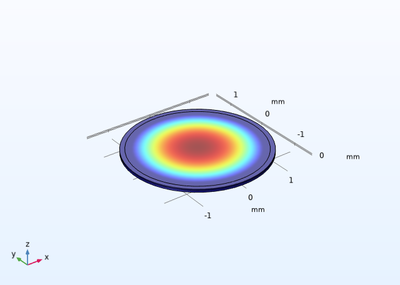
This 2D axisymmetric model demonstrates the operation of a pyroelectric detector found in instruments for measuring laser energy. A disk of lithium niobate (LiNbO3) is sandwiched between two electrodes and connected to an external circuit. The disk is mounted on a ring-shaped ... Per saperne di più
The elastic cantilever beam is one of the elementary structures used in MEMS designs. This model shows the bending of a cantilever beam under an applied electrostatic load. The model solves the deformation of the beam under an applied voltage. Per saperne di più

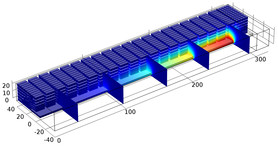
In food industries, microwave heating is gaining attention over a conventional heating treatment because of several advantages such as precise process control, speed of heating, fast turn-on and turn-off time, etc. In this model, a high directional Yagi-Uda antenna is used to heat up ... Per saperne di più


