
La Galleria delle Applicazioni raccoglie un'ampia varietà di tutorial e di app dimostrative realizzati con COMSOL Multiphysics in diversi ambiti applicativi, inclusi quelli elettrico, meccanico, fluidico e chimico. E' possibile scaricare i file dei modelli e delle app demo pronti all'uso e le istruzioni step-by-step per costruirli, e utilizzarli come punto di partenza per le proprie simulazioni.
Lo strumento di Ricerca Rapida permette di trovare i modelli che si riferiscono alla propria area di interesse.
Si noti che molti degli esempi qui presentati sono accessibili anche tramite le Librerie delle Applicazioni incorporate nel software COMSOL Multiphysics® e disponibili dal menu File.
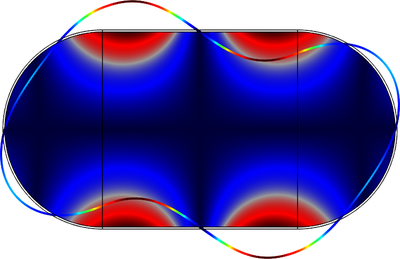
This example consists of a 2D analysis of propagation modes in the chamber of a muffler. In this case, the muffler walls are considered to be made of a linear elastic material and account for their influence on the modes propagating through the cross section of the chamber. This analysis ... Per saperne di più

Example of a moving-coil loudspeaker where lumped parameters represent the behavior of the electrical and mechanical components. The Thiele-Small parameters (small-signal parameters) serve as input to the lumped model, which is represented using the Electric Circuit interface. The ... Per saperne di più
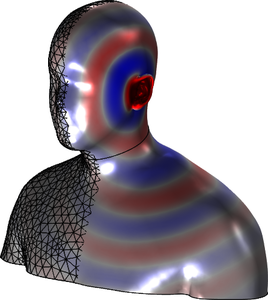
This tutorial model shows how to import a 3D scanned geometry of a human head and torso and compute the head related transfer function (HRTF). The scan is imported as a .stl file and converted into a COMSOL geometry. The HRTF is computed using the reciprocity principle, locating the ... Per saperne di più
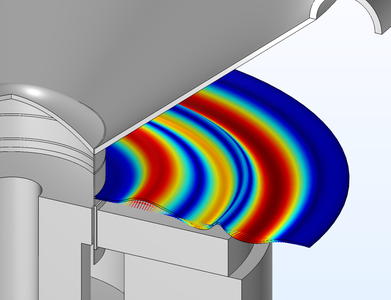
The suspension of a loudspeaker is designed to keep the membrane in place and avoid any rocking movement of the voice coil. At low frequencies, where the displacement of the membrane is significant, the stiffness of the suspension varies along the movement of the voice coil. This ... Per saperne di più
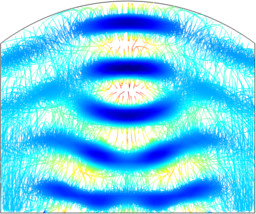
An ultrasonic standing wave levitator, also called acoustic levitator, is a device used for levitating fluid and solid particles in an acoustic field. The standing acoustic waves exert an acoustic radiation force on the particles. The force is a second order effect and stems from a ... Per saperne di più

Model of the sound radiation from a circular duct with uniform flow. The convected acoustic problem is described using the linearized potential flow equations, solved in the frequency domain. The acoustic inlet is treated including higher order modes using the Port boundary condition and ... Per saperne di più
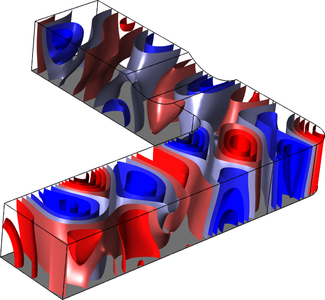
In this tutorial the acoustic behavior of a duct or waveguide with a right angled bend is analyzed. The model uses port boundary conditions at the inlet and outlet. The ports can capture and treat non-plane propagating modes in waveguides, extending the analysis above the first cutoff ... Per saperne di più
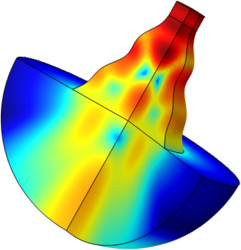
A plane-wave mode feeds an axisymmetric horn radiating from an infinite baffle toward an open half space. The radius of the waveguide attached to the horn throat is assumed to be fixed, as well as the depth of the horn and the size of the horn mouth attached to the baffle. By varying the ... Per saperne di più

The vibration modes of a thin or thick circular disc are well known, and it is possible to compute the corresponding eigenfrequencies to arbitrary precision from a series solution. The same is true for the acoustic modes of an air-filled cylinder with perfectly rigid walls. A more ... Per saperne di più
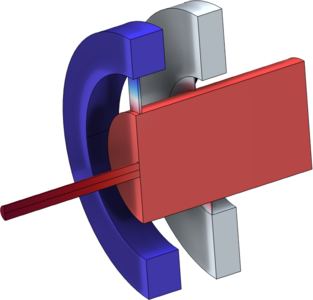
This model computes the input impedance/admittance to an acoustic system in the frequency domain. The system here represents a typical measurement setup used for testing hearing aids and includes domains with thermoviscous boundary layer losses. The input admittance, computed in the ... Per saperne di più


