COMSOL Day: AI for Modeling and Simulation
See what is possible with multiphysics modeling
Join us for COMSOL Day: AI for Modeling and Simulation to learn how AI and machine learning can be used together with multiphysics modeling and simulation.
The technical sessions will cover how the COMSOL Multiphysics® software can be used to generate synthetic simulation data for training AI models, create surrogate models, analyze models using uncertainty quantification, and develop simulation apps and digital twins. We will also look at emerging uses of generative and agentic AI with COMSOL Multiphysics®.
Keynote speakers will share insights from their work and demonstrate how they are incorporating AI into their modeling and simulation workflows. The day will conclude with a panel discussion on current applications and future opportunities for AI in modeling and simulation.
Schedule
Join this session for an overview of COMSOL Multiphysics® and its capabilities for modeling and simulation in a wide range of engineering and scientific applications. In addition to highlighting these capabilities, we will show how physics-based simulation can be used together with AI tools.
We will also preview topics that will be covered in more detail during the COMSOL Day, including the use of synthetic multiphysics data for AI training and generative and agentic AI workflows with COMSOL Multiphysics®.
Physics AI models are only as good as the data used to train them, yet high-quality physics-modeling-based datasets are often scarce, expensive, or difficult to obtain experimentally. In this webinar, we will discuss how the COMSOL Multiphysics® software can be used to generate synthetic data for training physics AI models by simulating single-physics and coupled physics systems for a range of design parameters. There will be simulation examples from structural mechanics, CFD, electromagnetics, acoustics, chemical, and electrochemical engineering.
The presentation will highlight efficient parametric sweeps using design of experiments methods, data extraction, and cluster sweeps, as well as examples of trained physics AI models that can be developed for use in simulation apps, optimization, uncertainty quantification, and digital twins.
To obtain accurate results when designing models, it is important to take uncertainties that occur in real-world scenarios into consideration. By applying probabilistic design, engineers and researchers can look into questions such as how manufacturing tolerances affect the intended performance of a final product and how to prevent the over- and underdesign of devices and processes. The Uncertainty Quantification Module, an add-on to the COMSOL Multiphysics® software, quantifies risk with statistical metrics that are more informative than traditional deterministic methods. Specialized solver technologies and analysis tools are used to expand models and produce more encompassing, accurate, and useful model versions.
Join us in this session to learn about the different methods available in the Uncertainty Quantification Module for performing screening, sensitivity analysis of different parameters, uncertainty propagation analysis, and other types of uncertainty quantification. You will also see how the Uncertainty Quantification Module can be used with any kind of physics simulation, such as structural, chemical, acoustics, fluid flow, and electromagnetics applications.
Modeling and simulation is no longer limited to the expertise of a few individuals within an organization. The availability of simulation tools throughout the product or process design workflow — from R&D to the factory floor — allows for a more collaborative and innovative approach to problem solving. Now, even those without prior modeling knowledge can contribute to the process, leveraging the expertise of modeling experts and advanced techniques like digital twins and surrogate models.
To facilitate this collaboration, the Application Builder in the COMSOL Multiphysics® software enables modeling experts to create custom apps with user-friendly interfaces that can be employed by scientists and engineers with no modeling experience. In addition, COMSOL Compiler™, an add-on product, enables organization-wide use of standalone simulation apps without licensing restrictions.
By using the Application Builder and COMSOL Compiler™ together with the COMSOL Multiphysics® platform's built-in Model Builder and Model Manager, engineering organizations can establish an efficient, collaborative, simulation-based workflow that is supported by the realistic and predictive capabilities of digital twins and surrogate models.
Join this session to learn how the Application Builder and COMSOL Compiler™ can transform your organization's approach to simulation, making advanced tools accessible and fostering a culture of collaborative innovation.
Generative and agentic AI can support engineering simulation by helping users find information, generate code, automate repetitive tasks, and interact with simulation software using natural language. COMSOL Multiphysics® includes tools and programming interfaces that can be used for these types of AI-assisted functions.
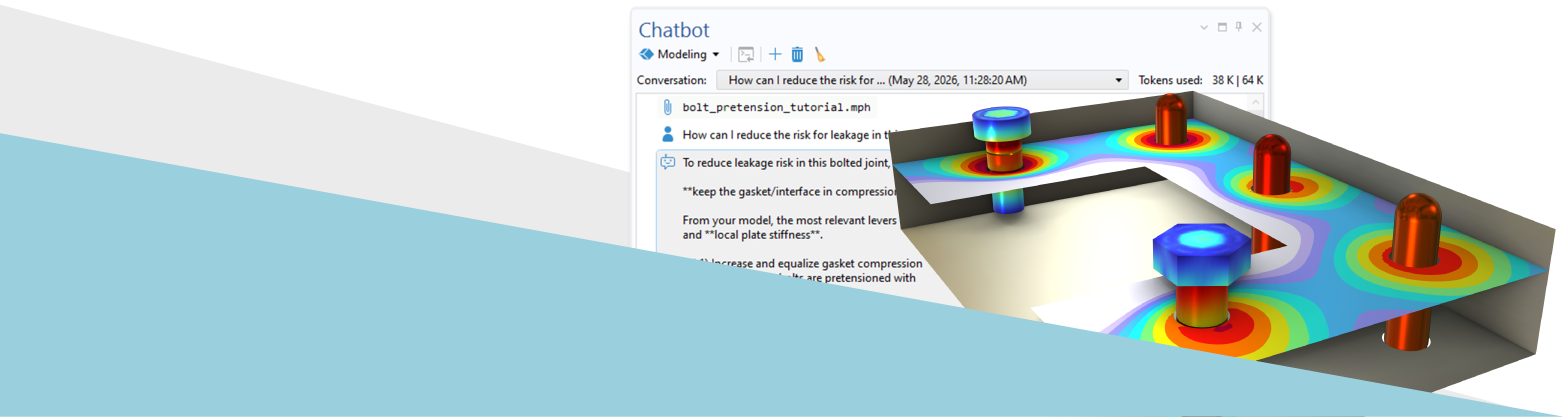
The integrated Chatbot window can help generate and debug Java API code, answer questions about modeling features, and review information about model setup. Agentic workflows can extend this functionality by allowing a large language model to create, run, inspect, and evaluate COMSOL models through the COMSOL API.
In this session, we will introduce generative and agentic AI workflows with COMSOL Multiphysics®. We will demonstrate how the Chatbot window can support modeling and programming tasks and show how an AI agent can automate parts of a simulation workflow.
The tools available to engineers and researchers for modeling and simulation are changing rapidly. Advances in computing hardware, AI, and numerical methods are making it possible to solve larger models, automate parts of the modeling workflow, and use simulation results in new ways. At the same time, the underlying need to represent the relevant physics and understand the assumptions in a model remains.
In this panel discussion, experts will share their perspectives on how these developments may affect the use of multiphysics simulation in engineering and research. The discussion will cover, for example, AI-enhanced methods for setting up and analyzing models, surrogate modeling and optimization, GPU-accelerated computation, and approaches for working with larger numbers of simulations and simulation-generated data.
Another topic will be how physics-based models can be made useful to those outside of the group that originally developed them. Simulation apps, digital twins, and automated workflows provide different ways of giving more people access to the benefits of multiphysics simulation while retaining the physics and numerical methods on which the models are based. Emerging agentic approaches may provide additional possibilities for interacting with and making use of simulation models.
The panelists will discuss where these technologies are useful today, where there are still limitations, and how the role of the simulation specialist may develop as modeling tools become more automated and more widely used.
Join us for a discussion on how AI tools are changing multiphysics modeling and simulation and what this may mean for users of COMSOL Multiphysics®.
Register for COMSOL Day: AI for Modeling and Simulation
To register for the event, please create a new account or log into your existing account.
You will need a COMSOL Access account to attend COMSOL Day: AI for Modeling and Simulation.
COMSOL Day Details
November 19, 2026 | 10:00 a.m. CET (UTC+01:00)