
La Galleria delle Applicazioni raccoglie un'ampia varietà di tutorial e di app dimostrative realizzati con COMSOL Multiphysics in diversi ambiti applicativi, inclusi quelli elettrico, meccanico, fluidico e chimico. E' possibile scaricare i file dei modelli e delle app demo pronti all'uso e le istruzioni step-by-step per costruirli, e utilizzarli come punto di partenza per le proprie simulazioni.
Lo strumento di Ricerca Rapida permette di trovare i modelli che si riferiscono alla propria area di interesse.
Si noti che molti degli esempi qui presentati sono accessibili anche tramite le Librerie delle Applicazioni incorporate nel software COMSOL Multiphysics® e disponibili dal menu File.
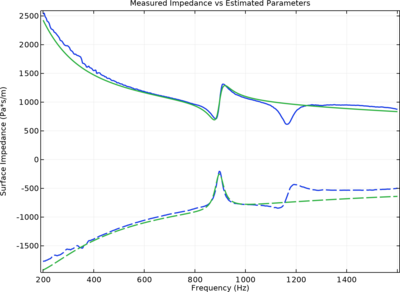
This app is an example of how the poroelastic properties of a porous material can be determined based on measurement done with an impedance tube and parameter estimation. Being able to determine the characteristics of a porous material from a single and simple measurement opens the door ... Per saperne di più
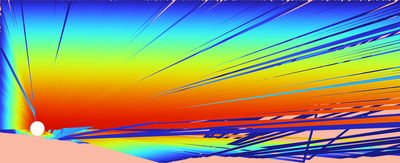
This example model simulates the long-path echo of trumpet sounds reflected from a building 500 m away. The echo can only be heard at night because of the acoustic ray refraction in the atmosphere with different temperature profiles. The model is solved using the ray tracing in the ... Per saperne di più

A demultiplexer is a device that directs different frequency bands to different outputs. In this tutorial model, we will design a demultiplexer by performing shape optimization on all initial circular boundaries in a sonic crystal (phononic crystal) configuration. The model uses shape ... Per saperne di più
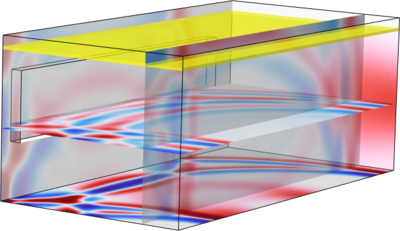
This example presents how different sound absorption models can make a difference in room acoustics with a wave-based, time-domain acoustics simulation. It also introduces how to obtain a band-limited impulse response for room acoustic evaluation using time-domain modeling. You can ... Per saperne di più
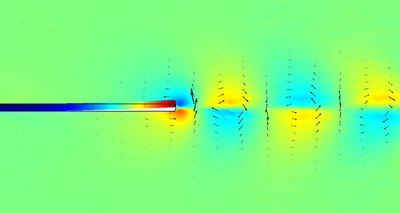
This is a small 2D demonstration model that couples the Linearized Navier-Stokes, Frequency Domain, Solid Mechanics, and Turbulent Flow (k-epsilon) physics interfaces to model the vibrations of a plate located in a 2D viscous parallel plate flow. This type of model is used to model fluid ... Per saperne di più

This model utilizes the thermoviscous acoustic interface in a sub-model to obtain detailed results for the transfer impedance of a perforated plate (including the thermal and viscous losses). The impedance is in turn used as an internal impedance in a pressure acoustic model of a ... Per saperne di più

This tutorial shows how to model car cabin acoustics using a low frequency FEM solution concatenated with a high frequency ray solution. The source is a tweeter located in the dashboard corner, which is modeled as a lumped loudspeaker coupled to an electric circuit. To accurately include ... Per saperne di più

This model demonstrates two approaches to model the acoustics in a generic nacelle with an acoustic liner and a background flow. The first method uses the Compressible Potential Flow and the Linearized Potential Flow, Frequency Domain interfaces, while the second, more detailed approach, ... Per saperne di più

This small tutorial model shows how to set up a model with a solid mechanics and a pressure acoustics domain including a common perfectly matched layer (PML). The PML is used to model an open or infinite domain for both the elastic waves and the pressure waves. Three configurations of ... Per saperne di più

This model studies a small orifice located in a duct. The transmission and reflection coefficients of the system are computed in the presence of a bias flow using the linearized Navier-Stokes equations. For certain frequencies the transmission coefficient shows amplification (T>1). This ... Per saperne di più


